AI Made Expert Coders Slower — Then They Refused to Give It Up
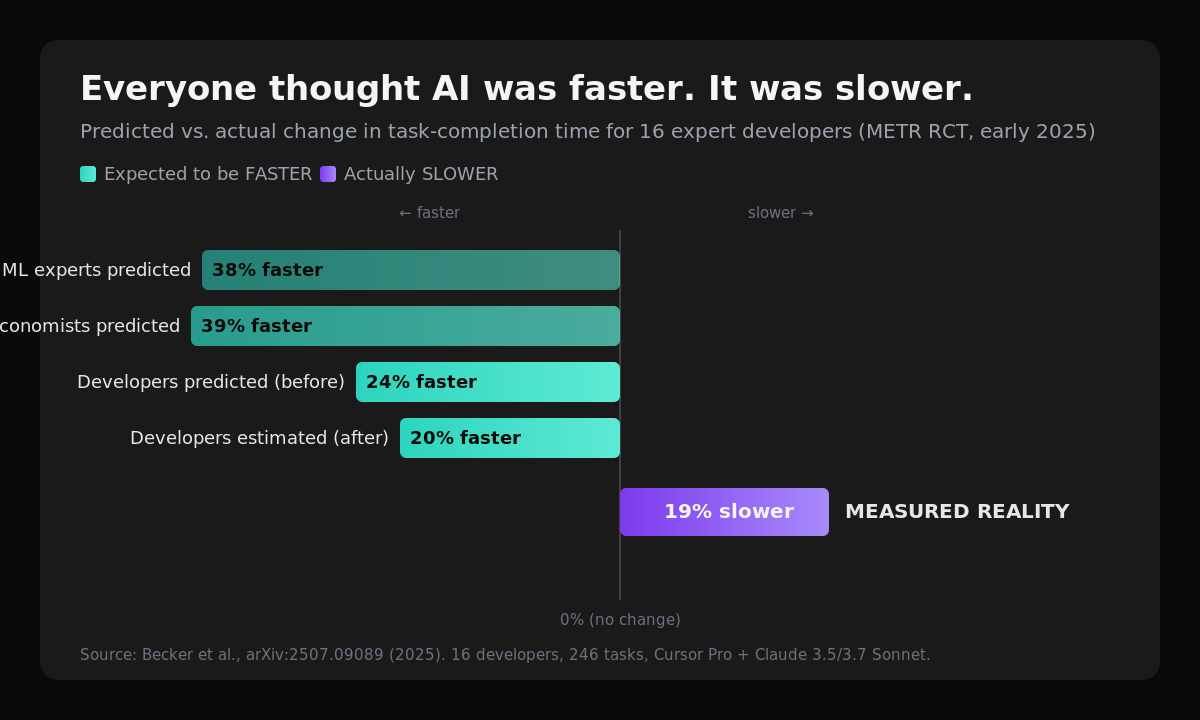
Here's a result almost nobody wanted: in the most rigorous experiment yet on AI and software development, the AI made experienced programmers slower — and they never noticed. METR's randomized controlled trial had sixteen seasoned open-source developers work 246 real tasks on codebases they knew for years, each randomly marked "AI allowed" or not, on the best early-2025 tools (Cursor Pro, Claude 3.5/3.7 Sonnet). They predicted a 24% speedup and felt about 20% faster; the measured result was 19% slower ([Becker et al., arXiv 2507.09089](https://arxiv.org/abs/2507.09089)). Outside experts guessing +39% and +38% were no better.
Why the "AI slowed me down" study mattered
It cut against an article of faith: by 2025, "AI makes developers dramatically more productive" was simply expected to be true. What METR found is what psychologists would predict — people are unreliable narrators of their own efficiency. AI feels productive (fluent code, no blank page), but on a mature, million-line codebase the expert spends the saved minutes re-reading and re-prompting, and the momentum hides the lost time. This was a narrow, hostile-to-AI setup by design — not a verdict on all programming — but it was real, measured, and it punctured the hype.
Then the twist: nobody will sit still long enough to re-run it
Then it gets stranger. METR tried to rerun the study from August 2025 with a bigger pool — 57 developers, 143 repositories, 800+ tasks — and it quietly fell apart ([METR, February 2026](https://metr.org/blog/2026-02-24-uplift-update/)). The data was fine; developers no longer wanted to take part, because the study sometimes required working without AI. Between 30% and 50% admitted to skipping the tasks where AI would obviously help — one said the old way felt like walking across the city after getting used to an Uber. That self-selection broke the experiment: the raw 2026 numbers even flipped to a speedup, but METR calls them unreliable. In a year, AI coding went from "measurably slows experts down" to "so embedded you can't find a control group."
Both sides, fairly
The skeptic's case is strong. The only rigorous, randomized evidence showed a slowdown, and every softer measure — surveys, self-reports, vibes — is exactly what that study proved untrustworthy. METR's May 2026 survey of 349 technical workers reported a median value gain of 1.4–2x and speed gain of 3x ([METR, May 2026](https://metr.org/blog/2026-05-11-ai-usage-survey/)) — while warning the figures are likely inflated, and noting METR's own staff, most aware of the perception gap, report the lowest gains of all.
The believer's case is also strong. The slowdown study used early-2025 tools on a worst-case population, and tools have since turned genuinely agentic. The strongest evidence is behavioral: the median worker in METR's survey would give up 29% of a month's salary to keep AI access. It's hard to dismiss developers who'd rather sabotage a study than code without a model — revealed preference beats opinion.
So what — for your work, not just theirs
Three lessons travel beyond software. First, distrust your sense of speed — feeling faster and being faster are different variables, and only timing your output tells the truth. Second, watch the gap between speed and value: AI makes cheap tasks nearly free, which can look like a big speedup while adding little — or can unlock work never worth attempting before. Third, the measurement crisis is itself the signal: a lab can no longer run a clean experiment because the technology has gone ambient, and "without AI" is no longer a condition real people will tolerate.
Takeaway
The honest position in 2026 holds two facts at once: the best controlled evidence says AI's productivity boost is smaller and slipperier than the hype, and people are terrible at judging it themselves — yet the same people, given the choice, won't go back. The future isn't a clean number on a slide; it's the quiet moment when walking feels unbearable because you've gotten used to the Uber. At least notice when it happens to you.