The First Rung Is Disappearing — And Nobody Agrees Why
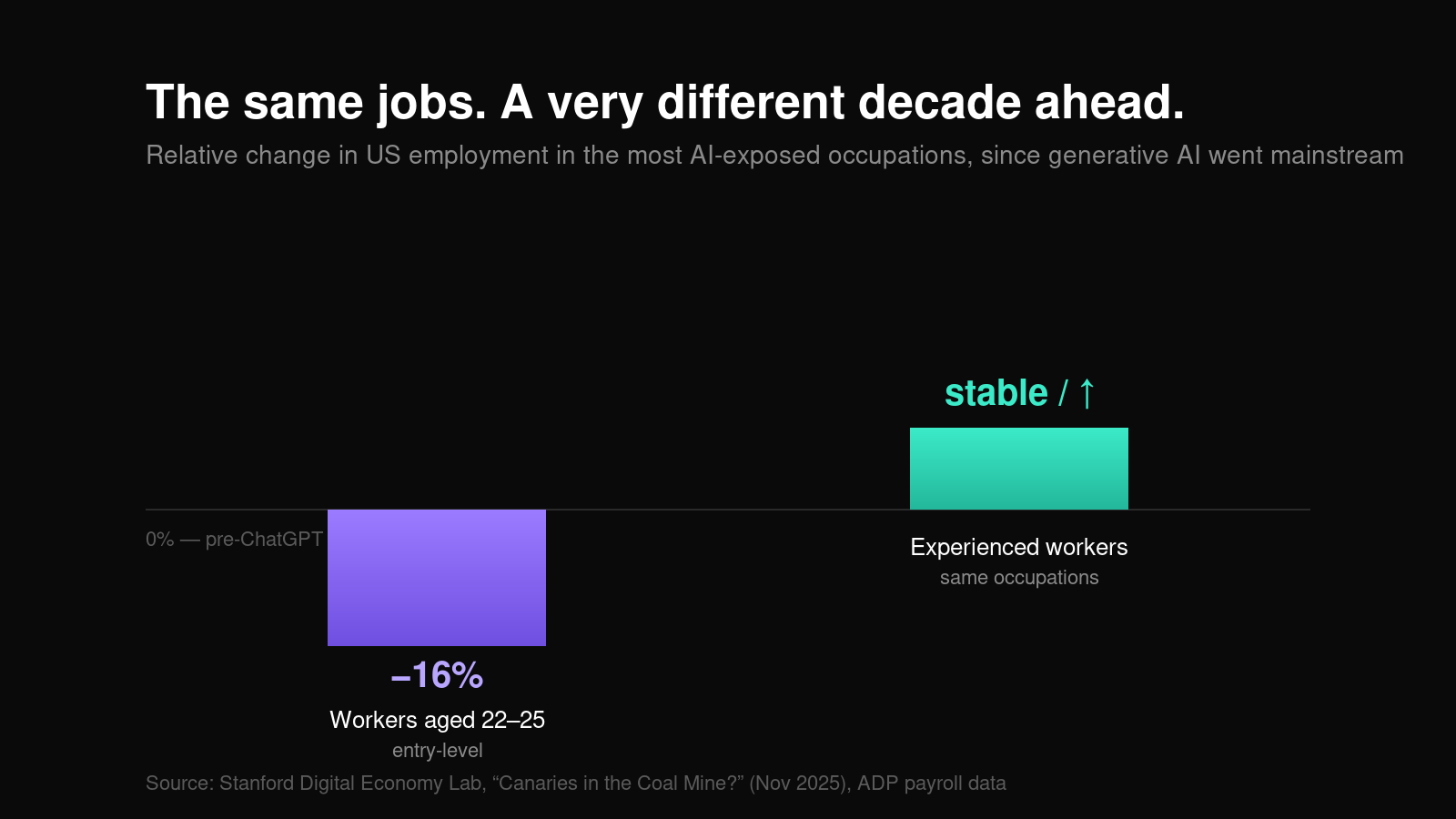
Here's a number that should make any 23-year-old pause: since generative AI went mainstream, employment for workers aged 22–25 in the most AI-exposed occupations has fallen 16% relative to everyone else — even after stripping out company-specific shocks. That's not a forecast. It's payroll data from millions of US workers, published by Stanford's Digital Economy Lab.
The same week that finding made the rounds, PwC's 2026 Global AI Jobs Barometer told a sunnier story: workers with AI skills now command a 62% wage premium, up from 57% a year earlier, and headcount at the most AI-exposed companies is growing faster than at firms that can't use AI. So which is it — is AI eating jobs or minting them? The honest answer is both, and the split runs straight through the start of your career.
The core of the Stanford finding is its specificity. Older workers in the same AI-exposed jobs held steady or kept growing. The damage was concentrated among the youngest, and concentrated in tasks where AI automates rather than assists — software support, basic coding, routine clerical and customer-service work. Tellingly, firms adjusted by hiring fewer juniors, not by cutting pay. The bottom rung is quietly being sawed off.
Now the strongest version of each side. The pessimists argue this is the canary in the coal mine: entry-level work has always been where humans do the predictable, learnable tasks — exactly what today's models do cheaply. Remove those tasks and you remove the on-ramp, hollowing out the experience that produces tomorrow's seniors. The optimists counter that the macro picture, not AI, is doing the cutting — high interest rates squeezed junior hiring across the economy, and the Stanford authors themselves published a February 2026 follow-up wrestling with exactly that objection. They also point to PwC's evidence that AI-exposed sectors are expanding headcount and rewarding new skills lavishly. In their telling, the ladder isn't shrinking; it's being rebuilt one rung higher, and the people who learn to direct AI climb fastest.
Both can be true at once. AI is dissolving the old entry-level job — the one defined by doing routine work by hand — while creating a new one defined by supervising, editing, and deploying AI to do it. The catch is that the new rung demands judgment we used to expect people to acquire on the old rung. That's the squeeze: employers increasingly want junior hires who already think like seniors.
So what does this mean for you? If your work touches AI-exposed tasks, fluency with these tools is shifting from a nice-to-have to the thing that decides which side of the split you land on. The most exposed jobs are also, paradoxically, the ones where AI skill pays the steepest premium.
The career ladder isn't vanishing. But its first rung now expects you to arrive already knowing how to work alongside the machine — and the gap between those who do and those who don't is widening by the quarter.