You Can Tell People a Video Is Fake. They Believe It Anyway.
There is a comforting story we tell ourselves about deepfakes. Yes, AI can now fabricate a video of anyone saying anything. But we'll label the fakes. A little badge, a content warning, a line of text from the platform — this video is AI-generated — and the spell breaks. Forewarned is forearmed.
A study published this year in Communications Psychology, part of the Nature portfolio, suggests that comforting story is mostly wrong. Across three preregistered experiments, researchers Sarah Clark and Stephan Lewandowsky at the University of Bristol showed people a deepfake video of someone appearing to confess to a crime or a moral lapse. In some conditions they warned participants, clearly and in advance, that the video was fake. Then they asked: is this person guilty?
The warning helped. But it did not break the spell. And in the people who said they fully believed the warning — who knew, by their own account, that they were watching a fabrication — the video still moved the needle on guilt. Seeing was believing, even when they'd been told there was nothing real to see.
What they actually found
In the third experiment, participants watched a fabricated clip of a vegan influencer eating a burger. With no warning, 87.5% concluded she was guilty of the hypocrisy on the basis of the video. With a specific warning that the clip was a deepfake, that dropped to 56% — a real reduction, but still a majority convinced by footage they'd been told was invented.
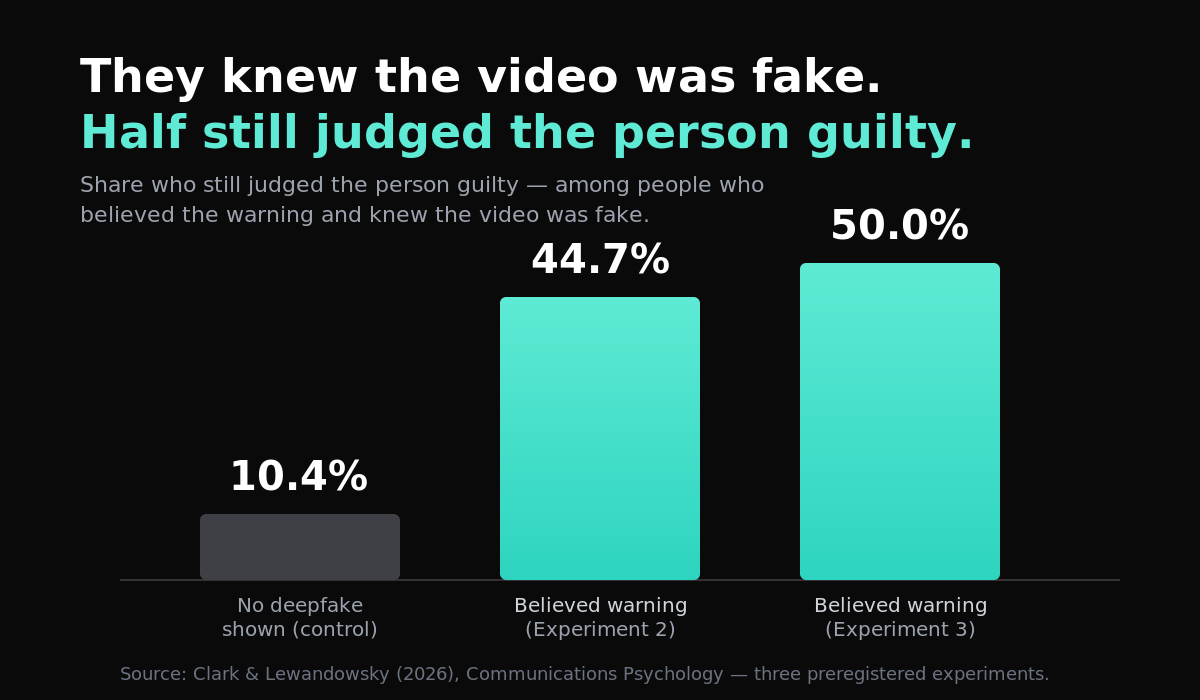
The sharper result came from a subset the researchers isolated: people who saw the warning, and afterward confirmed they believed it and knew the video was fake. Among that group, half (50% in experiment three; about 45% in experiment two) still relied on the content of the video to judge the person guilty. In the control groups, that figure was far lower. Knowing it was fake was not enough to stop the fake from doing its work.
The effect held across two completely different videos — a politician taking a bribe, an influencer breaking her own rules; an older man, a younger woman; serious crime, trivial hypocrisy; old-fashioned face-swap tech and newer generative AI. Different fakes, same stubborn pull.
Why this is the whole ballgame
Here's why a modest psychology study matters far beyond the lab. Transparency — labeling AI content — is the central pillar of how governments plan to handle synthetic media. The EU's AI Act, in Article 50, leans heavily on disclosure: tell people when content is AI-generated, and you've discharged much of your duty. Platforms are rolling out "AI-generated" tags. The implicit bet is that an informed viewer is a protected viewer.
Clark and Lewandowsky's results poke a hole in that bet. If the label reduces belief by a third but a majority still swallow the lie — and if the people most sure it's fake are still influenced — then transparency is a speed bump, not a wall. As the authors put it, flagging deepfakes online "is insufficient," and stronger measures such as removing the content "should therefore be considered."
It gets worse in the other direction, too. In one condition the researchers showed people a real video and falsely labeled it a deepfake — and many believed the label, doubting genuine footage. That's the "liar's dividend": once everyone knows fakes exist, anyone caught on camera can simply cry deepfake. The same warning that's supposed to protect truth can be turned into a tool for denying it.
The case for the other side
This is one study, and the honest version includes its limits — several of which the authors flag themselves. The scenarios were fictional, the "crimes" were playacted by actors, and participants knew they were in an experiment. Judging a made-up character in a made-up clip is not the same as sitting on a jury. The authors concede this "nested fiction" setup may have muddied how people read the video as evidence, and that some of the effect could reflect inattention rather than genuine susceptibility.
There's a fairer reading of transparency, too. The warning did work, partially — guilt judgments fell meaningfully. A third fewer people fooled is not nothing when the alternative is a fake spreading with no friction at all. And the proposed cure — removing or prohibiting deepfake content — runs straight into hard problems: who decides what's fake, how fast, and how a takedown regime avoids becoming a censorship regime that the powerful use to scrub inconvenient-but-real footage. Labels are clumsy, but they don't require a central authority deciding which videos get to exist. Defenders of disclosure would say the answer to a weak tool isn't to abandon it for a dangerous one, but to stack it with provenance standards, watermarking, and media literacy.
So what — for you
Strip away the academic framing and the finding is intimate. It's about how your own mind handles a convincing image. The study's deeper message is that "seeing is believing" is not a habit you can switch off by being told to. The picture lands first; the disclaimer arrives second, and arrives weaker. You can know, intellectually, that a clip is fabricated and still walk away with the feeling it left behind.
Practically, that reframes the next few years of online life. The job is shifting from spotting fakes — a label can do that — to resisting ones you already know are fake. Provenance will matter more than warnings: not "is this flagged?" but "where did this come from, and can the chain be traced?" For anyone who consumes news, sits on a jury, hires, votes, or simply argues on the internet, the practical rule tightens: a video is a claim, not a fact, and a single clip from an untraceable source deserves the same skepticism you'd give an anonymous quote.
Takeaway
The reassuring idea that we'll simply label our way out of the deepfake era took a hit this year. The label is worth keeping — it does some good — but it is not the shield it was sold as. The harder work is building systems that prove where media came from, and habits that treat striking footage as something to verify rather than something to feel. The technology that fakes reality is improving fast. Our instinct to believe our eyes has not changed in millennia, and a warning sticker, it turns out, doesn't change it much either.