Is AI Making Us Dumber? The Science Behind "Cognitive Debt"
A word is spreading through AI research labs that should make every knowledge worker pause: cognitive debt. The idea is simple and unsettling — every time you let an AI do your thinking, you feel more productive, but you may be borrowing against your own brain, and the loan comes due later. We're all in the middle of an uncontrolled experiment on our own cognition. So let's look at what the science actually says — and the serious reasons to doubt the scariest version.
What the brain scans showed
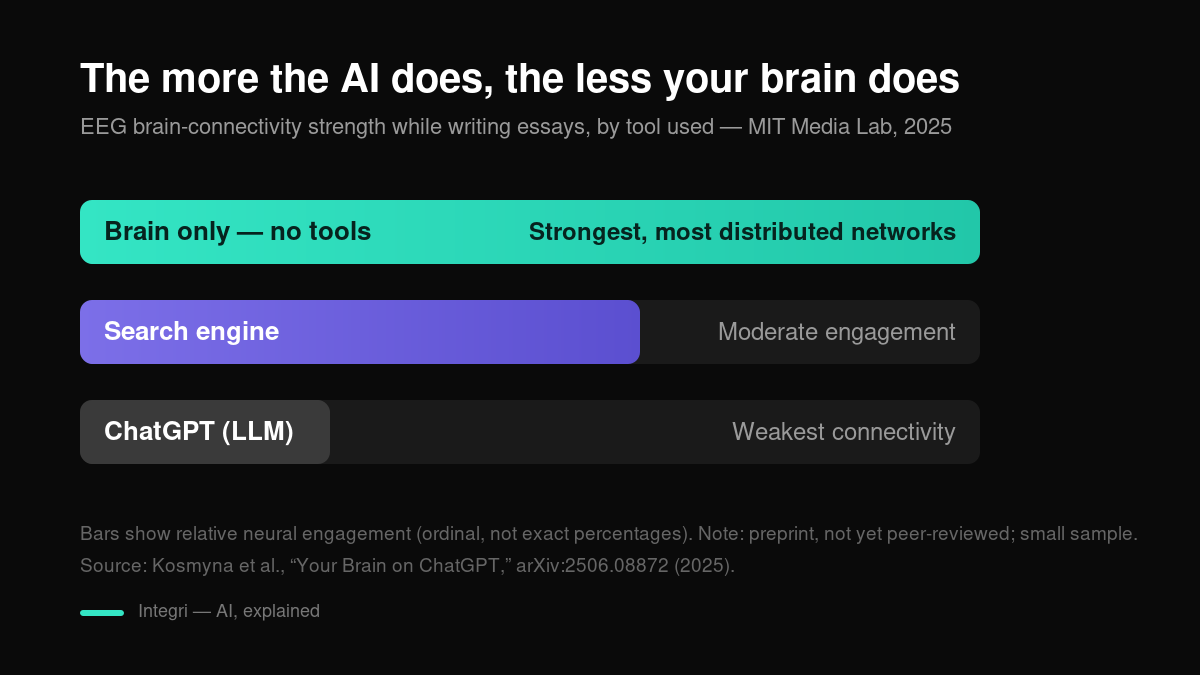
The claim went viral in 2025 when an MIT Media Lab team led by Nataliya Kosmyna wired people to EEG headsets as they wrote essays, in a study titled Your Brain on ChatGPT. Participants used ChatGPT, a search engine, or only their own minds. The pattern was consistent: brain-only writers showed the strongest neural networks, search users the middle, ChatGPT users the weakest. Worse, when AI users later wrote without the tool they underperformed, as if the mental muscles had gone slack. The authors called this cognitive debt. It wasn't isolated: a 2025 study by Michael Gerlich in Societies surveyed 666 people and found a significant negative correlation between heavy AI use and critical-thinking scores, strongest in younger users — what he dubbed "cognitive laziness."
Why the scary version might be wrong
Here's the part the headlines skipped: the MIT paper isn't peer-reviewed, and critics have torn into its limits. The numbers are tiny — the crucial fourth session, source of the "writing without AI gets harder" finding, included just 18 people, as few as nine per group; a 2026 critique noted you'd need roughly 159 for reliable conclusions. And your brain is naturally less active when a tool does part of the work — that's what tools are for — so lower effort isn't long-term decline. Then comes the awkward counter-evidence: a 2025 Harvard randomized trial in Nature Scientific Reports split 194 physics students between an AI tutor and an active-learning class. The tutored students didn't get dumber — they learned more than twice as much, more engaged and in less time, because that AI was built for good teaching: scaffolding, withholding answers, prompting the student to think.
Same tool, opposite outcomes
Side by side, the contradiction resolves into something more useful than yes-or-no. When AI is used to replace thinking — write my essay, give me the answer — it appears to reduce engagement and may weaken the skill over time. When it scaffolds thinking — quiz me, push back, make me defend my reasoning — it can accelerate learning beyond a human classroom. Same tool; the outcome flips on whether it does the work for you or makes you do it better. That reframes cognitive debt from a property of AI into one of how we use it.
What this means for your actual day
For most people the real risk isn't sci-fi brain atrophy but a subtler drift: outsourcing the small acts of thinking — drafting the email, structuring the argument, recalling the fact — until the habit of effort fades. The skills you don't practice are the ones you lose, and AI makes it frictionless to stop. The defense is the same at work as in class: use AI to pressure-test your ideas, not manufacture them. Write the messy first draft yourself, then let the model critique it; ask it to argue against you; make it explain its reasoning rather than swallowing the output whole. A tool sharpens or dulls you depending on whether you stay in the loop.
The takeaway
The honest state of the science in mid-2026 is this: there is real, if early and contested, evidence that passively offloading thinking to AI lowers engagement and may erode skill — and equally real evidence that AI built to make you think can supercharge learning. Anyone selling certainty in either direction is ahead of the data. What's not in doubt is that the choice is ours, made daily, mostly without noticing. The generation growing up with an AI in every pocket will run this experiment for real. The least we can do is decide, deliberately, whether we're using these tools to think or to avoid thinking. The brain you keep depends on the answer.