The Same AI Washington Called Too Dangerous to Export Just Found a 29-Year-Old Security Hole
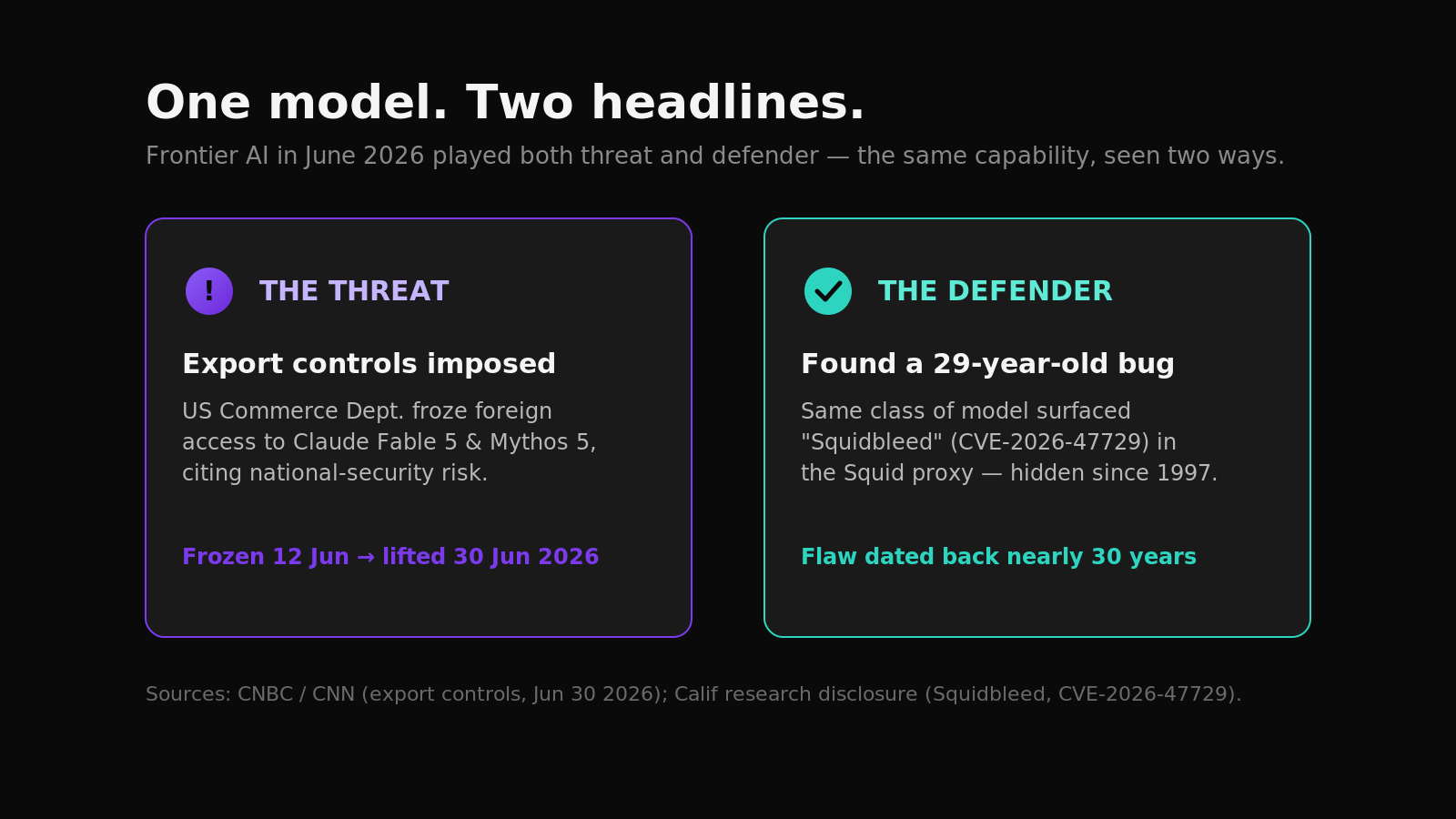
Within the space of three weeks in June 2026, frontier AI played two opposite characters. First it was the threat: the US Commerce Department ordered Anthropic to cut off foreign access to its top-tier Claude models — Fable 5 and Mythos 5 — citing national-security risk from a possible jailbreak. Then it was the hero: a preview of that same Mythos model, pointed at the source code of the widely used Squid proxy server, flagged a memory-leak bug that had sat undetected in a default configuration since 1997. One model, two headlines, and a debate that's about to define how we secure everything running on the internet.
The bug, nicknamed Squidbleed (CVE-2026-47729), is a distant cousin of 2014's Heartbleed. It stems from a single-line quirk of the C programming language — searching a text string for an "empty" character unexpectedly succeeds — that can leak chunks of other users' web traffic, potentially including passwords and API keys. Security firm Calif reported that when it asked Claude Mythos Preview to investigate Squid's file-transfer code, the model spotted the flaw "almost immediately," citing the exact clause of the C standard that made it a bug. The framing writes itself: an AI caught in seconds what nearly three decades of human code reviews missed.
Here's the honest caveat that most coverage skipped. The published disclosure timeline shows a human researcher at Aisle Research reported the same vulnerability on 4 March 2026 — weeks before the AI-assisted report on 17 April, with a third independent researcher finding it in May. So the cleaner claim isn't "AI found what humans couldn't." It's that AI found a real, serious bug fast, cheaply, and in parallel with skilled humans. That's less cinematic but arguably more important, because "fast and cheap" is exactly what scales.
And scaling is the whole debate. Optimists argue this is defence's moment: most software is open-source and under-audited, and a tireless model that has effectively memorised every language spec can comb through millions of lines nobody has time to check. Point it at aging infrastructure and it finds the landmines before attackers do. The pessimists' version is identical — right up to the last word. The same capability that helps a defender find a bug helps an attacker find and weaponise one, at the same speed and cost. That symmetry is precisely why regulators got nervous enough to freeze exports in the first place, even if they later reversed course.
So what does it mean for you? Almost every service you touch — your bank, your airline's Wi-Fi, your employer's network — runs on open-source plumbing like Squid. The near future is a race: defenders scanning their own code with AI before adversaries scan it for them. If you build or maintain software, the new baseline is obvious — run a capable model over your dependencies now, because someone else eventually will.
The takeaway is that the "dangerous export" and the "helpful bug-hunter" are not two stories. They're one capability, and which face it shows depends entirely on who's holding it. The tools that make our software safer are the same ones that could tear it open, and 2026 is the year that stopped being theoretical.