Science's New Gatekeeper Is an AI That Detects AI — and It Just Rejected 178 Papers
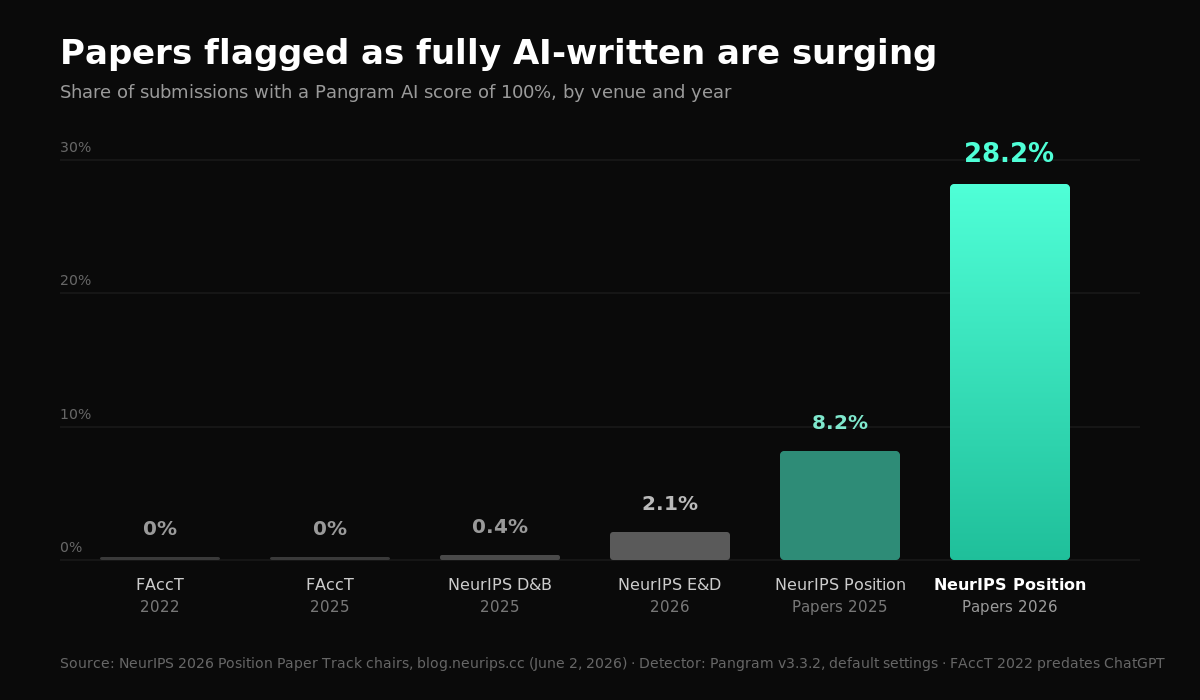
The world's most important AI conference just used an AI to reject research about AI — and nobody can fully prove it got the calls right. On June 2, NeurIPS announced that 178 papers in its 2026 Position Paper Track (18.4% of submissions) will be desk-rejected after a commercial AI detector judged them substantially machine-written. Another 123 (12.7%) sit in limbo, with until June 15 to prove — via version histories — that a human wrote the work. Nearly one in three papers in a track about the future and ethics of AI was flagged as machine-written, by a machine.
What actually happened
The track's new rule required papers to be "substantially human-written," with AI allowed only for copy-editing. Organizers ran all 969 submissions through Pangram, a commercial detector: 28.2% scored a full 100%, meaning it judged essentially every section AI-generated. The trend is steep — venues before ChatGPT scored 0%, NeurIPS's 2025 Datasets & Benchmarks track 0.4%, the 2025 Position Paper Track 8.2%, versus 28.2% now. They didn't trust raw scores alone: they stress-tested the detector across twelve scenarios (spell-checking never flagged; fully AI-authored passages reliably were), re-ran it with smaller text windows, and weighed authors' AI-use declarations before rejecting. And it isn't isolated — in March, Nature reported a conference rejected 497 papers for LLM-written reviews caught via watermarks.
The case for the crackdown
The organizers' argument is subtler than "AI bad." Position papers are arguments — a researcher's own stance, in their own words. If an AI writes the text, reviewers can't tell whether the ideas were human-conceived and verified or are fluent confabulation. As the chairs put it, AI-generated text "externalises the cost of verifying that work, imposing it on reviewers" — and peer review runs on scarce, unpaid expert labor. Tuhin Chakrabarty asked bluntly on X why a human should read a Claude-generated position. Defenders also note Pangram's audited false-positive rate under 0.1%, and that it flagged only 1% of accepted ICLR 2026 papers — so 28.2% is hard to dismiss as noise.
The case against
The backlash was immediate, and it isn't just sour grapes. First, calibration: changing one knob — the size of the text windows analyzed — dropped the share scoring 90%+ from 42.7% to 12.7%. Careers are decided by a threshold authors can't see, on a closed-source tool they can't audit; as @kirancodes noted, a proprietary service now effectively decides what gets published. Second, detectors measure who strung the words together, not who did the thinking. Harry Wang ran his own paper — his ideas, AI-drafted prose — and it flagged 73%; his hand-written post scored 100% AI. Jessica Hullman noted we want human perspective but settle for human typing; Pasquale Minervini half-joked his em-dashes would flag him; Yuntian Deng asked why prose is sacred when we accept AI writing the code. The organizers themselves admit responsible users are "often indistinguishable" from violators — and their fix, version-history audit trails, may become the norm: write with a paper trail, or be presumed a bot.
Why this matters beyond academia
This fight previews something coming to your workplace. The same question — does it matter who wrote the words, if the thinking was yours? — applies to your reports, proposals, reviews and cover letters. Most knowledge workers already write the way Harry Wang does: human ideas, machine prose, iterated. And the enforcement model matters as much as the rule: NeurIPS chose detection-plus-presumption, where an algorithm flags you and the burden of proof shifts to you. If that spreads — to hiring, education, law — keeping receipts of your own thinking becomes basic professional hygiene.
The takeaway
Both sides are right, which is what makes this hard. Peer review genuinely cannot survive unlimited machine-generated submissions; and detectors genuinely cannot tell a lazy prompt-and-paste from a researcher who thinks in collaboration with a machine. NeurIPS didn't solve that dilemma — it went first, loudly. By June 15, 123 researchers will learn whether their version histories satisfy an appeals process designed on the fly. The rest of us should watch closely: how science answers "who really wrote this?" will shape how your employer, your bank and your government answer it too.