An AI that can work for a full week, alone, by 2028? The data behind the boldest claim in tech
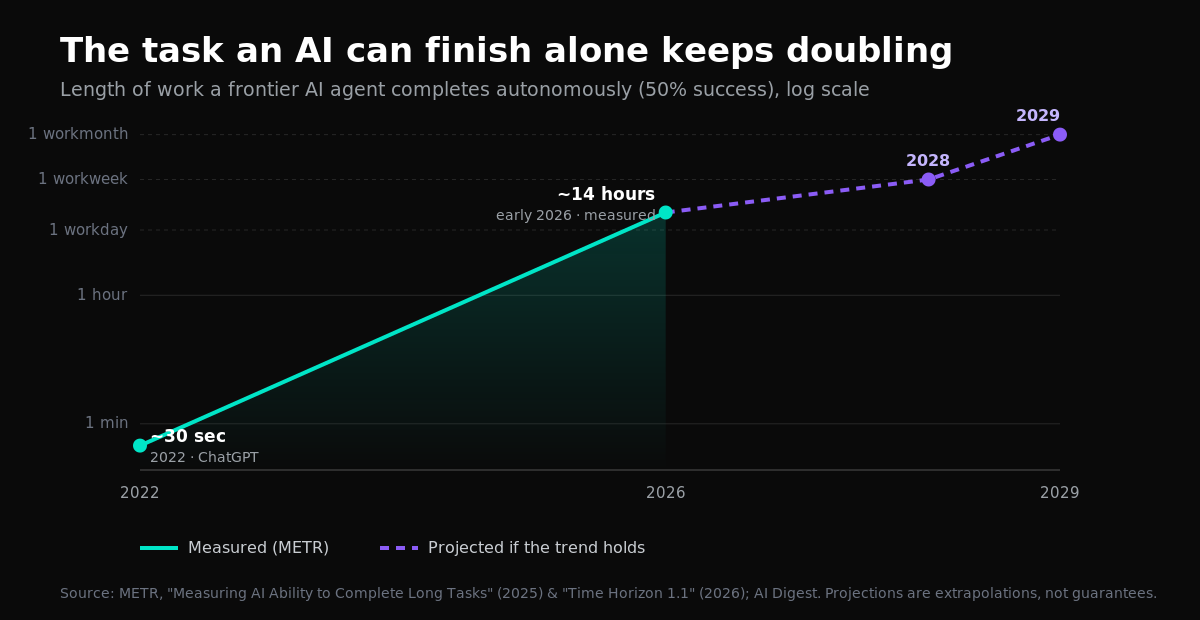
There's a chart making the rounds in AI circles that's either the most important graph of the decade or a statistical mirage. It comes from METR, a nonprofit that measures what frontier AI systems can actually do, and it tracks a single number: the length of task an AI agent can complete on its own, without a human babysitting it.
In 2022, when ChatGPT launched, that number was about 30 seconds of equivalent human work. By early 2026 it had climbed to over fourteen hours. And the line is almost perfectly straight on a log scale — which is the scary part. METR found the "time horizon" of AI agents has been doubling roughly every seven months for six years, with a correlation so tight (R² = 0.83) it looks more like a law of physics than a trend in a messy field ([METR](https://metr.org/blog/2025-03-19-measuring-ai-ability-to-complete-long-tasks/); [AI Digest](https://theaidigest.org/time-horizons)).
Extend that line and you get a forecast that sounds like science fiction: AI agents handling a full work day of autonomous work by 2027, a full work week by 2028, and a work month by 2029 ([AI Digest](https://theaidigest.org/time-horizons)). If that holds, it is one of the most consequential things happening on Earth right now. So the only question that matters is: does the line hold?
What the number actually measures
First, what METR did, because the method is unusually honest. Researchers took the strongest AI agents from 2019 to 2026 and ran them on a suite of around 230 tasks — mostly software engineering and technical reasoning — each one timed by how long it takes a skilled human professional. Tasks ranged from under 30 seconds to more than 8 hours. The "time horizon" is the task length the AI can complete with a 50% success rate ([METR](https://metr.org/blog/2025-03-19-measuring-ai-ability-to-complete-long-tasks/)).
The point is not that the AI is good at week-long work. It's that the duration of work it can string together without losing the plot keeps doubling. Short tasks were conquered years ago; the frontier is now measured in hours, climbing toward days.
And here's the detail that turned a lot of skeptics quiet. In January 2026, METR re-ran the analysis with a bigger, cleaned-up task set (228 tasks instead of 170) and new evaluation software. The headline trend barely moved — the long-run doubling time came out at 196 days, essentially identical to the original. But looking only at models since 2024, the doubling time was 89 days: under three months ([METR Time Horizon 1.1](https://metr.org/blog/2026-1-29-time-horizon-1-1/)). The trend isn't just holding. Recently it has been accelerating.
The bull case: this is the most important trend in history
If you take the data at face value, the implications are enormous. An AI that can reliably run a week-long project is not a chatbot — it's a junior employee that never sleeps, costs pennies per hour, and can be copied a thousand times. Whole categories of knowledge work that today require a person to hold context over days — drafting a legal filing, debugging a sprawling codebase, running a research review — come into range.
There's also a reason to think the line could bend upward, not flatten. As AI gets better at writing AI, it starts speeding up its own development — a flywheel where more capable agents help build the next, even more capable agents ([AI Digest](https://theaidigest.org/time-horizons)). METR's own caveat is telling: they keep having to redesign their tests because the newest models are running out of tasks hard enough to fail ([METR Time Horizon 1.1](https://metr.org/blog/2026-1-29-time-horizon-1-1/)). When your measuring stick is too short, the thing you're measuring is moving fast.
The bear case: a straight line is not a promise
Now the other side, and it's stronger than the hype crowd admits.
A trend line is a description of the past, not a guarantee about the future. Extrapolating six years of doubling out to 2029 assumes nothing breaks — no data wall, no scaling slowdown, no plateau where the next doubling simply costs too much. METR itself is careful here: the recent four-month doubling rests on only a year or so of data, which makes it a far shakier basis for prediction than the long-run number ([AI Digest](https://theaidigest.org/time-horizons)).
There's a subtler problem too. "50% success on benchmark tasks" is not the same as "can be trusted to do your job." An agent that finishes a week-long task half the time is, in most real workplaces, useless — because you can't tell in advance which half you're getting, and checking its work can cost as much as doing it yourself. This gap between lab scores and the messy real world is now its own field of study; one 2026 analysis found a 37% gap between enterprise agents' benchmark performance and their real deployment results ([arXiv: Beyond Accuracy](https://arxiv.org/html/2511.14136v1)).
And then there's the most uncomfortable data point of all — produced by METR, the same lab behind the famous chart. In a randomized controlled trial, the gold standard of evidence, they had experienced open-source developers do real tasks with and without AI tools. The developers predicted AI would make them 24% faster. Afterward, they believed it had made them 20% faster. In fact, they were 19% slower with the AI tools than without ([METR](https://metr.org/blog/2025-07-10-early-2025-ai-experienced-os-dev-study/); [arXiv](https://arxiv.org/abs/2507.09089)). The capability was real; the productivity was negative; and the humans couldn't even feel the difference.
So what — for your work and your week
Hold both findings at once, because both are real, and the tension between them is the actual story.
Raw capability is climbing exponentially and shows no sign of stopping. Realized value — what actually shows up as faster, better, cheaper work — is lagging badly and is much harder to measure. METR's own May 2026 survey of 349 technical workers found a median self-reported gain of 1.4–2x from AI tools, while warning there are real reasons to doubt the size of that number ([METR](https://metr.org/blog/2026-05-11-ai-usage-survey/)). People consistently feel more productive than the stopwatch says they are.
For your week, that suggests a few concrete things. The work most exposed isn't creative or strategic — it's the long, self-contained, verifiable task: the kind where success is obvious and a wrong answer is cheap to catch. Coding, data wrangling, document drafting, structured research. The durable human edge is shifting from doing those tasks to specifying and checking them — deciding what should be done and verifying it was done right, because the trial shows our gut feeling about AI's help is not to be trusted. And if you manage anyone, the lesson is to measure outcomes, not vibes. The single most reliable finding in this whole area is that people are bad at sensing whether AI sped them up.
Takeaway
The honest reading is that the bull and bear cases aren't really in conflict — they're describing two different curves. One is what AI can do, and it's bending toward week-long autonomy frighteningly fast. The other is what AI actually delivers in a real job, and it's lagging, noisy, and easy to overstate. The interesting years ahead will be defined by how fast the second curve catches up to the first. Watch the gap between them — that, not any single benchmark, is where the future of your work will be decided.