The Machine Wrote the Paper. Should Science Trust It?
An artificial-intelligence system wrote a scientific paper, and human reviewers didn't catch it. That is not a hypothetical. In a paper published in Nature this year, a system called "The AI Scientist," built by Tokyo's Sakana AI, ran the full research loop on its own — reviewing literature, forming a hypothesis, running experiments, writing it up — and one of its papers cleared the first round of peer review for a workshop at ICLR, a top machine-learning conference ([Nature, 25 March 2026](https://www.nature.com/articles/d41586-026-00934-w)). The finding itself was mundane: a technique that failed to improve how neural networks learn. The point was who produced it.
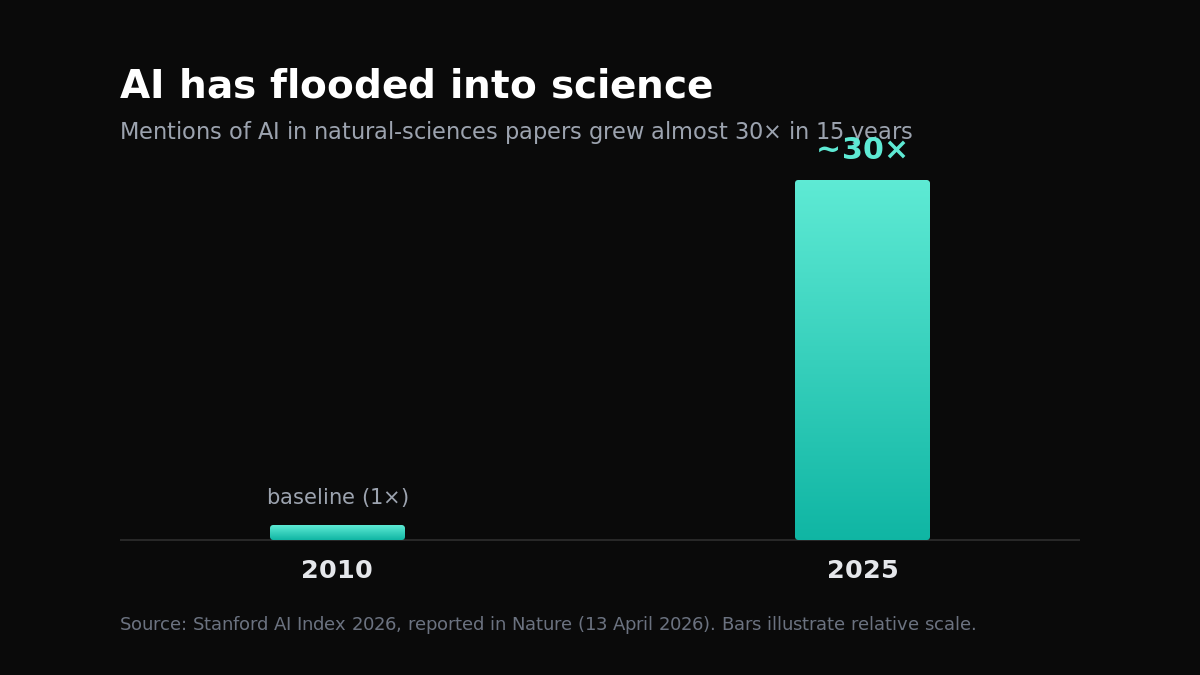
That milestone lands in the middle of a genuine fight over what AI is doing to science. On 30 June 2026, Nature published two more multi-agent systems — including Google's "AI Co-Scientist" — that generate biomedical hypotheses and design ways to test them, pushing toward a discovery cycle with AI in every step ([Nature, 30 June 2026](https://www.nature.com/articles/d41586-026-01873-2)). Mentions of AI in natural-sciences papers grew almost 30-fold between 2010 and 2025 ([Stanford AI Index 2026, via Nature](https://www.nature.com/articles/d41586-026-01199-z)). The tools are here, and researchers are grabbing them.
The optimists' case is straightforward and strong. Science is bottlenecked by how much any human can read, compute and try. If a machine can churn through a data-rich hypothesis space overnight, it removes drudgery the way calculators removed arithmetic — freeing people for judgment and design. Early evidence suggests AI genuinely makes individual researchers more productive ([Hao et al., Nature 2026](https://doi.org/10.1038/s41586-025-09922-y)). In fields such as drug discovery, where the search space is enormous and testable, that speed could translate directly into cures.
The skeptics' case is just as concrete. These systems still hallucinate data and invent citations, and they struggle to gauge their own confidence — the one thing a calculator never got wrong. Worse is the volume problem: models that iterate an analysis until something looks significant are, in effect, automated P-hacking — mass-produced "one-click science" that could bury real peer review under plausible-looking noise. And the same Tsinghua study that found productivity gains also found AI shrinks the number of topics researchers explore, nudging science toward a data-rich monoculture ([Nature, 25 March 2026](https://www.nature.com/articles/d41586-026-00934-w)). There's also a reality check on the hype: a 2026 state-of-the-field report found human scientists still decisively outperform the best AI agents on genuinely complex tasks ([Nature, 13 April 2026](https://www.nature.com/articles/d41586-026-01199-z)).
Here's why this matters beyond the lab. The medicines, materials and climate fixes that shape everyday life all start as research papers. If AI accelerates that pipeline honestly, we get answers faster. If it floods the system with confident-sounding garbage, we get the opposite: overloaded reviewers, retracted findings, and a harder time telling signal from noise — a problem that eventually reaches everyone who relies on science, which is everyone. It also reshapes work inside the lab: if machines do the tasks junior researchers once cut their teeth on, where does the next generation learn to be skeptical?
The honest read is that both things are true at once. AI can now do real parts of science, and it can now generate real slop at scale — and the same tool does both depending on who runs it and how. The technology isn't the deciding factor anymore; the guardrails are. The question for the next few years isn't whether machines can do science. It's whether we build the checks to tell good machine-made science from the flood.