The Seven-Month Rule: AI's Most Important Chart — and the Fight Over What It Really Means
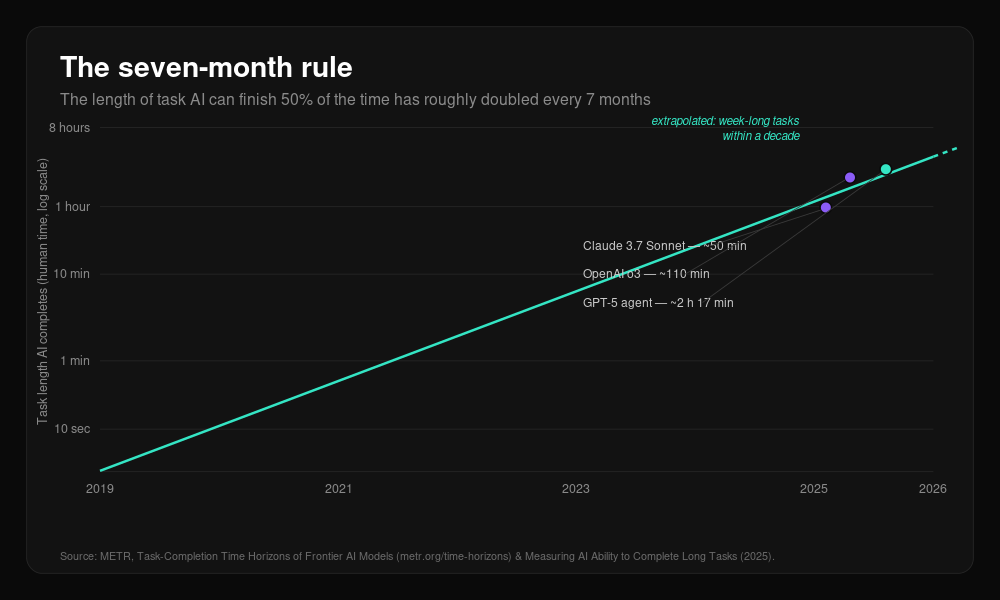
Here is a claim that should make you stop scrolling: the length of a job an AI can finish by itself has been doubling roughly every seven months for six years. Extend that line and sometime this decade you'll hand an agent a week-long task and walk away. That, or you've been shown the most seductive straight line in tech, drawn through data that doesn't mean what it looks like. Both readings come from one source — which is what makes it the best argument in AI right now.
What the number actually measures
The metric comes from METR, a nonprofit that stress-tests frontier AI. Instead of asking whether a model is "smart," it asks how long a task the model can reliably complete: the 50%-task-completion time horizon — the length of a job (measured by how long a human expert needs) that an AI finishes successfully half the time. ([METR](https://metr.org/time-horizons/))
Measured this way, progress looks less like a vibe and more like Moore's Law: METR found the 50% horizon doubling about every seven months since 2019, with hints it sped up in 2024. ([METR paper](https://metr.org/blog/2025-03-19-measuring-ai-ability-to-complete-long-tasks/)) Claude 3.7 Sonnet hit near 50 minutes in early 2025, o3 around 110, a GPT-5 agent roughly two hours seventeen — versus seconds six years ago. ([METR](https://metr.org/time-horizons/)) METR's paper says agents may "reliably complete week-long tasks with meaningful probability" within a decade.
The bull case: this is the real exponential
Supporters note this isn't one cherry-picked point — it's a clean trend across more than a hundred tasks and six years of models from every major lab, and METR sees no sign of the curve bending. ([METR](https://metr.org/time-horizons/)) The "so what" is concrete: a two-hour horizon already covers writing a script or debugging a defined problem. Push it to a day, then a week, and AI shifts from a tool you supervise to a junior colleague who never sleeps.
The bear case: a clean lab is not a messy job
Now the other side, and it's strong. First, the tasks are narrow and tidy: METR's suite is mostly software, ML, and cybersecurity problems that are self-contained and automatically gradeable, while real work draws on context, hallway conversations, and goals no script can score. METR is blunt that an "8-hour time horizon" doesn't mean AI can do eight hours of a professional's day. ([METR](https://metr.org/time-horizons/)) Re-scored holistically instead of clean pass/fail, the numbers dropped. ([METR](https://metr.org/blog/2025-08-12-research-update-towards-reconciling-slowdown-with-time-horizons/))
Second, and most damaging: in a randomized trial, experienced open-source developers using early-2025 AI tools on their own repositories were 19% slower with AI than without — yet they expected a 24% speed-up and, even after finishing, still believed AI had made them about 20% faster. ([METR](https://metr.org/blog/2025-07-10-early-2025-ai-experienced-os-dev-study/)) The chart says capability is exploding; the field says the people closest to it can't tell whether it's helping.
Third, 50% reliability isn't a number you'd accept from an employee — useful autonomous work needs closer to 99%, and that figure is far shakier. Building on analysis by Gus Hamilton, philosopher Toby Ord argues agents' failure rate actually declines the longer a task runs (a "decreasing hazard rate"), so depending on the model you trust, the 99% horizon could be a twentieth of what optimists assume. ([Toby Ord](https://www.tobyord.com/writing/hazard-rates-for-ai-agents-decline)) The data, Ord concludes, doesn't tell us which is right.
So what — for your work and your week
Strip away the fight and a practical picture remains. AI is measurably getting better at longer chains of self-directed work, faster than most expected — that trend is real. But the leap from "succeeds half the time on a clean two-hour coding task" to "reliably runs your week-long project" crosses two gaps the chart hides: tidy benchmarks to messy reality, and 50% to near-perfect reliability. What resists automation is judgment — and the trial warns that checking AI can quietly eat the gains.
The takeaway
The seven-month rule is the closest thing AI has to a Moore's Law, and it deserves watching. But a trend line is a measurement, not a prophecy. The question for 2026 isn't whether the line keeps climbing; it's whether the messy, high-reliability work that fills real jobs follows it up the curve — or stubbornly refuses to. Bet on the slope if you like. Just don't confuse a clean benchmark for your actual Tuesday.