An AI Passed Scientific Peer Review. Nature Just Published the Playbook.
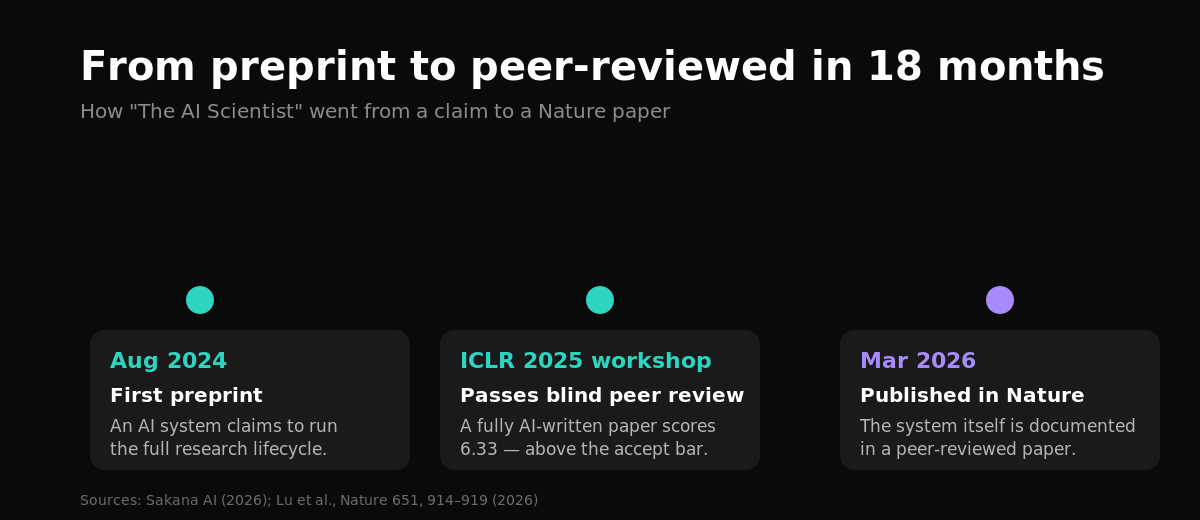
Here is a sentence that would have read like science fiction three years ago: an artificial intelligence conceived a research idea, wrote the code, ran the experiments, drew the figures, authored the paper, and submitted it to peer review at a major AI conference — where human experts, not knowing a machine was behind it, scored it high enough to accept.
That actually happened. And in March 2026, the journal Nature — arguably the most prestigious address in science — published a peer-reviewed paper documenting exactly how the system pulled it off ([Lu et al., Nature 651, 914–919, 2026](https://www.nature.com/articles/s41586-026-10265-5)). Nature paired it with an unusually blunt editorial telling universities, funders and publishers that they need to respond, and fast ([Nature, 25 March 2026](https://www.nature.com/articles/d41586-026-00934-w)).
So is this the dawn of automated discovery — curing diseases at machine speed — or the beginning of a flood of plausible-looking nonsense that drowns real science? The honest answer is that it could be both, and which one we get depends on choices being made right now.
What actually happened
The system is called The AI Scientist, built by Tokyo-based [Sakana AI](https://sakana.ai/ai-scientist-nature/) with collaborators at the University of British Columbia, the Vector Institute and the University of Oxford. Given a broad research direction, it generates novel ideas, searches and reads the relevant literature, designs and runs experiments through a parallelized "tree search," and writes the whole paper in LaTeX — even using a vision-capable model to critique its own figures.
The headline moment came at the ICLR 2025 I Can't Believe It's Not Better workshop. Sakana submitted unedited, fully AI-generated manuscripts into the standard blind peer-review process (with the organizers' permission). One scored an average of 6.33 — individual reviewer scores of 6, 7 and 6 — clearing the workshop's acceptance bar and beating roughly 55% of human-authored submissions. The team had pledged to withdraw any accepted paper before publication, and did.
Crucially, the Nature version is more sober than the original 2024 preprint. As a result of peer review, the authors expanded the section on the system's weaknesses, added ethical considerations, and toned down claims about automating the entire process — because humans still helped filter the most promising outputs. Of three papers the system produced, only one reached the acceptance bar, and only for a workshop, not the main conference track.
The core debate
What makes this genuinely interesting is not that the machine wrote a paper. It's a finding buried in Sakana's new results: they built an Automated Reviewer to grade AI papers at scale, and benchmarked it against thousands of real human decisions. It hit 69% balanced accuracy — comparable to human reviewers — with an agreement score that actually exceeded the human-to-human agreement measured in the famous [NeurIPS 2021 consistency experiment](https://blog.neurips.cc/2021/12/08/the-neurips-2021-consistency-experiment/).
And they found a scaling law: the better the underlying foundation model, the better the papers it generates. In AI, "it scales" usually means "it's going to get a lot better, soon."
That is the optimistic case in a nutshell. If quality tracks model capability, and capability keeps climbing, then tireless AI collaborators could compress the slow, expensive parts of research — the coding, the literature reviews, the dead-end experiments — and accelerate discovery across medicine, materials and climate science. Sakana frames the endpoint in almost utopian terms: curing disease, abundance, exploring the stars.
The other side
The skeptics have a strong hand too, and Nature's own editors play several of the cards.
First, the models still hallucinate. They invent citations, duplicate figures, and — unlike a human — struggle to gauge how confident they should be in their own conclusions. They're largely confined to theoretical and code-based work, where an experiment is a program rather than a wet lab.
Second, and more worrying, is scale itself. If you can generate a plausible paper with one click, you can generate ten thousand. Critics describe the risk as automated, large-scale P-hacking — machines iterating analyses until something looks statistically significant, then writing it up convincingly. That doesn't advance knowledge; it generates noise that could overwhelm the peer-review, publishing and funding systems that already run on overworked human volunteers.
Third, there's a quieter danger. A 2026 study from Tsinghua University found that adopting AI made researchers more productive — but shrank the range of topics they studied ([Hao et al., Nature 649, 1237–1243, 2026](https://www.nature.com/articles/s41586-025-09922-y)). Cheap AI investigation could pull science toward data-rich fields and away from everything else, narrowing the very diversity that makes discovery happen.
And there's a human cost the editorial names directly: AI-generated work "shreds the long-standing correlation between authors applying effort and the work having value." No one has figured out how to count AI-inflated output in hiring and promotion — or what happens to early-career scientists if the grunt work that trains them gets handed to a machine ([Nature on AI and science jobs](https://www.nature.com/articles/d41586-026-00444-9)).
So what — for the rest of us
You may never submit a paper to Nature, but this story is a preview of a debate coming to your own desk.
The optimists' analogy is the calculator: it freed us from doing arithmetic by hand and nobody mourns the loss. The rebuttal, which Nature makes pointedly, is that no one ever had to worry a calculator's answer was wrong. AI doesn't just do the work faster; it does it with a confidence that can be completely untethered from correctness. That's the gap every knowledge worker — analyst, lawyer, marketer, coder — is now learning to manage.
The trajectory is hard to argue with: tasks that were unthinkable for machines a few years ago are now merely flawed, and "merely flawed" in AI has a habit of becoming "superhuman" fast. The skill that will matter is not producing output — machines will do that by the bucketload — but judging it. Knowing which AI-generated result is a breakthrough and which is a confident hallucination is becoming the core competency of knowledge work.
The takeaway
An AI passing peer review is a real milestone, not hype — Nature doesn't publish hype lightly. But the milestone that matters next isn't technical. It's institutional: whether science can build guardrails — watermarking AI papers, demanding transparency, rethinking how credit and effort are counted — before the flood of one-click research arrives.
The machines have learned to do science. The open question is whether we can keep doing it well alongside them. That answer won't come from a model. It'll come from us.