Everyone Blamed AI for Killing Entry-Level Jobs. A New Study Says We Got the Wrong Suspect.
For three years, the verdict seemed settled: generative AI is doing the work junior employees used to do, so companies have stopped hiring them. Now a study of 243 million new hires says we may have convicted the wrong suspect — and the real culprit is your home office.
The prosecution's case was strong. Stanford's Digital Economy Lab found that since generative AI went mainstream, employment for workers aged 22–25 in the most AI-exposed occupations fell about 13% relative to other groups — the famous "canaries in the coal mine" finding. Politicians, CEOs, and worried graduates have treated AI-driven displacement as fact ever since.
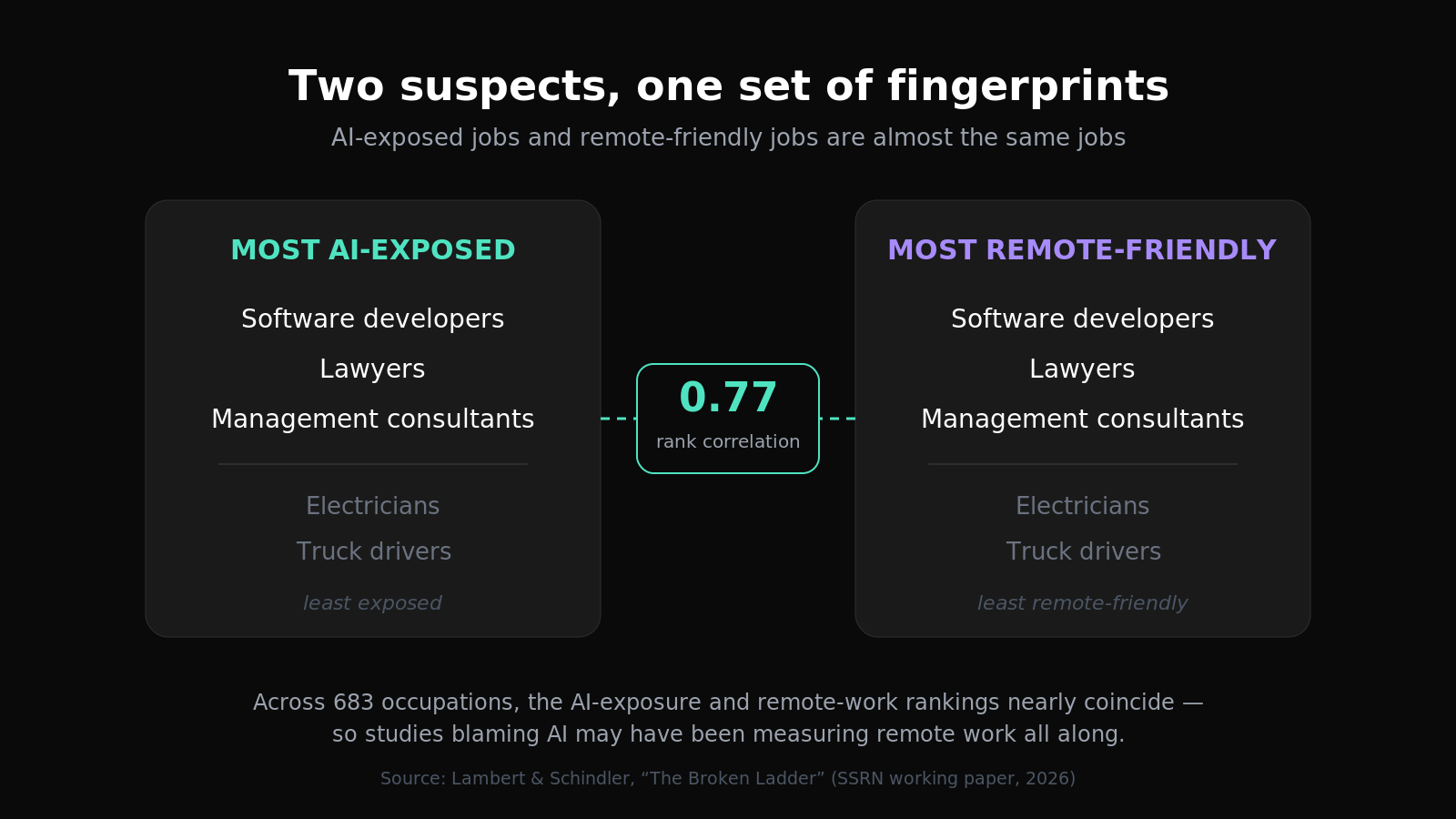
Enter The Broken Ladder, a working paper by Peter John Lambert (LSE/Warwick) and Yannick Schindler (Oxford's Ellison Institute), built on 243 million hire records and 407 million job postings across the US, UK, Canada, and Australia. Its trick is simple and devastating: the jobs most exposed to AI are almost exactly the jobs most suited to remote work. Across 683 occupations, the two exposure rankings correlate at 0.77 — software developers, lawyers, and consultants top both lists; electricians and truck drivers sit at the bottom of both. Measured alone, each factor predicts a 4–5 percentage-point drop in the junior share of new hires. Measured together, the remote-work effect stays large and significant — while the AI effect shrinks toward zero.
The proposed mechanism isn't replacement but disinvestment. Firms hire juniors as an investment: they're valuable for who they become by year five, not what they produce in year one. That investment depends on proximity — informal mentoring, watching seniors make decisions, fast feedback. Remote work quietly gutted those mechanisms, so rational firms shifted to hiring people already trained elsewhere. Supporting evidence fits: a Gartner survey found only 20% of customer-service leaders had actually cut staff because of AI, despite AI headlining countless layoff announcements, and IBM is tripling US entry-level hiring in roles explicitly redesigned around AI.
The AI camp isn't conceding. Stanford's data shows young workers' employment fell specifically in occupations where AI automates work, but not where it augments it — a split that remote work alone can't explain, since both kinds of jobs are done from home. Erik Brynjolfsson doubled down in June: the entry-level effect is real and "not going away." Both things can be true; the fight is over how much blame each deserves.
Why it matters: the two diagnoses demand opposite cures. If AI broke the ladder, we need retraining and policy. If remote work broke it, this is a fixable management failure — structured mentoring, deliberate in-person time for early-career staff, onboarding rebuilt for distributed teams. For anyone early in their career, the practical read is the same either way: presence is career capital right now. The unplanned learning that happens near experienced colleagues is exactly what both AI and distance make scarce — and the people who get it will pull ahead.
The ladder is broken either way. The question the next year of research must answer is which rung snapped first — because we're currently spending billions fixing the wrong one.