Are Young Workers the First Casualties of AI? A 16% Drop Says Maybe.
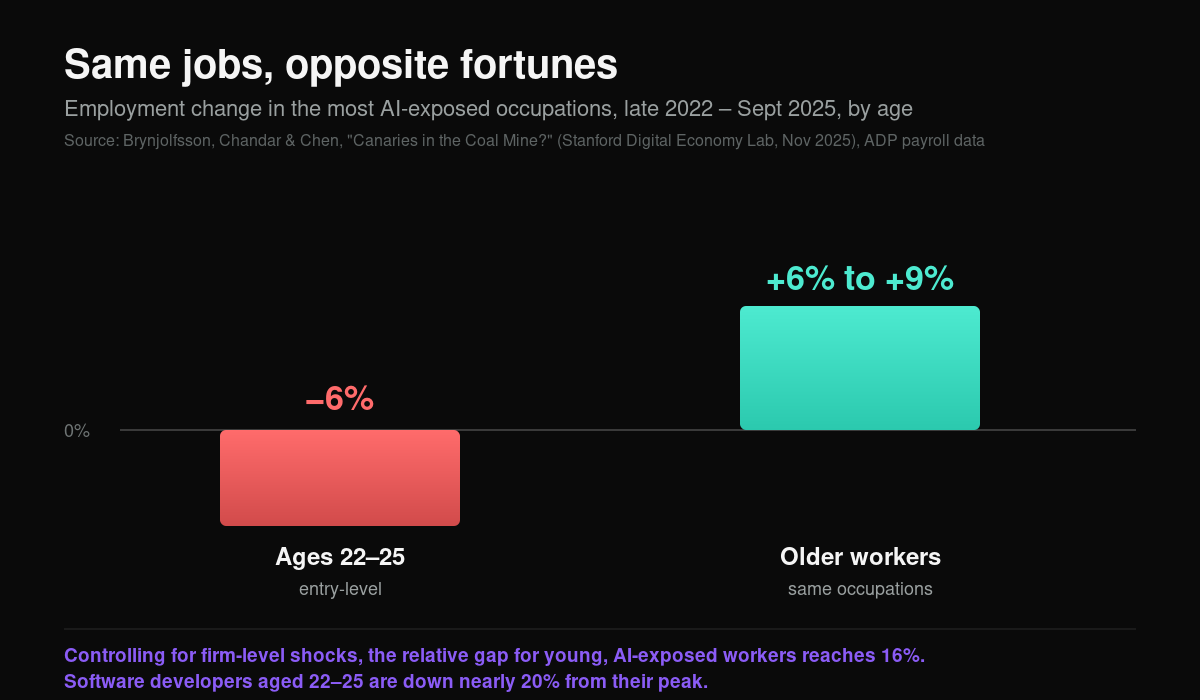
Here's a number worth stopping for: since generative AI went mainstream, workers aged 22–25 in the most AI-exposed jobs have seen employment fall 16% relative to everyone else — even after controlling for which companies they work for. Older colleagues in the same roles were largely fine. It's become a Rorschach test: the first hard evidence AI is closing the career ladder's bottom rung, or correlation dressed up as catastrophe. Both camps have a real case, and the disagreement is the story.
What the study actually found
The study is Canaries in the Coal Mine?, from Stanford Digital Economy Lab economists Brynjolfsson, Chandar, and Chen. Instead of surveys, they used monthly ADP payroll records — the largest US payroll provider — covering millions of workers through September 2025. That granularity is what makes it hard to wave away.
Six findings stand out. Young workers (22–25) in AI-exposed jobs like software and customer service saw employment fall while older workers in the same roles held steady; young software developers dropped nearly 20% from their peak. The pain concentrated where AI automates rather than augments, and survived firm-level controls. Tellingly, it showed up in headcount, not pay ([Stanford Digital Economy Lab](https://digitaleconomy.stanford.edu/publication/canaries-in-the-coal-mine-six-facts-about-the-recent-employment-effects-of-artificial-intelligence/)). The theory is elegant: AI excels at the codified knowledge juniors sell, while seniors trade in tacit instinct. The timing fits — declines from late 2022, as coding-AI leapt from 4.4% of benchmark problems in 2023 to 71.7% in 2024.
The strongest case against
Now the rebuttal, and it's a good one. The Budget Lab at Yale, tracking the same question with national survey data, finds no discernible AI-driven disruption more than two and a half years after ChatGPT. The economy's "occupational mix" is shifting no faster than during the rollout of computers or the internet ([The Budget Lab at Yale](https://budgetlab.yale.edu/research/evaluating-impact-ai-labor-market-current-state-affairs)).
Skeptics offer a simpler story: timing and money. Hiring for AI-exposed roles weakened in early 2022 — before ChatGPT — pointing to rate hikes and the correction after pandemic overhiring. Oxford's Fabian Stephany warns of "AI-washing": blaming the robot for layoffs really about overstaffing, since "we're replacing you with AI" beats "we over-hired in 2021" ([Fortune](https://fortune.com/2026/02/02/ai-labor-market-yale-budget-lab-ai-washing/)). Even the Stanford authors caution this is correlation, not proven causation.
So what — for your work and your kids' careers
Strip away the fencing and the stakes are large. If Stanford is right, the classic on-ramp — hired junior, learn on the job, climb — is narrowing exactly where AI is strongest. The danger isn't mass layoffs but a slow starvation of new openings; you can't be promoted from a job you were never hired into. And a paradox lurks: if firms stop training juniors, where do tomorrow's seniors come from?
If Yale is right, the panic is premature — general-purpose technologies reshape work over decades, not quarters. The honest synthesis: the strongest signal so far is narrow and recent — young, automatable roles — not an economy-wide apocalypse. The most defensible move is neither to fear AI nor ignore it, but to use it. The least-exposed workers do augmentative work, wielding AI as a power tool; fluency is becoming the new literacy, as spreadsheets were a generation ago.
The takeaway
We're watching the first arguments over the first data of a transition that will define a working lifetime. One study says the canaries are wobbling; another says the air is fine — both likely see part of the truth, and the gap will close as more data arrives. The smartest bet is neither denial nor dread, but to become the person who uses AI well, in a job it makes better rather than obsolete. The ladder isn't gone — but the bottom rung is moving. (The 16% figure is the November 2025 paper's relative decline after firm controls; earlier drafts were cited at 13% — same study.)