Guilty Until Proven Human: The World's Top AI Conference Just Rejected 178 Papers for AI Writing
The world's most prestigious AI conference has a new problem: too many of its papers appear to be written by AI. And its solution — using an AI detector to reject them — may be even more controversial than the problem itself.
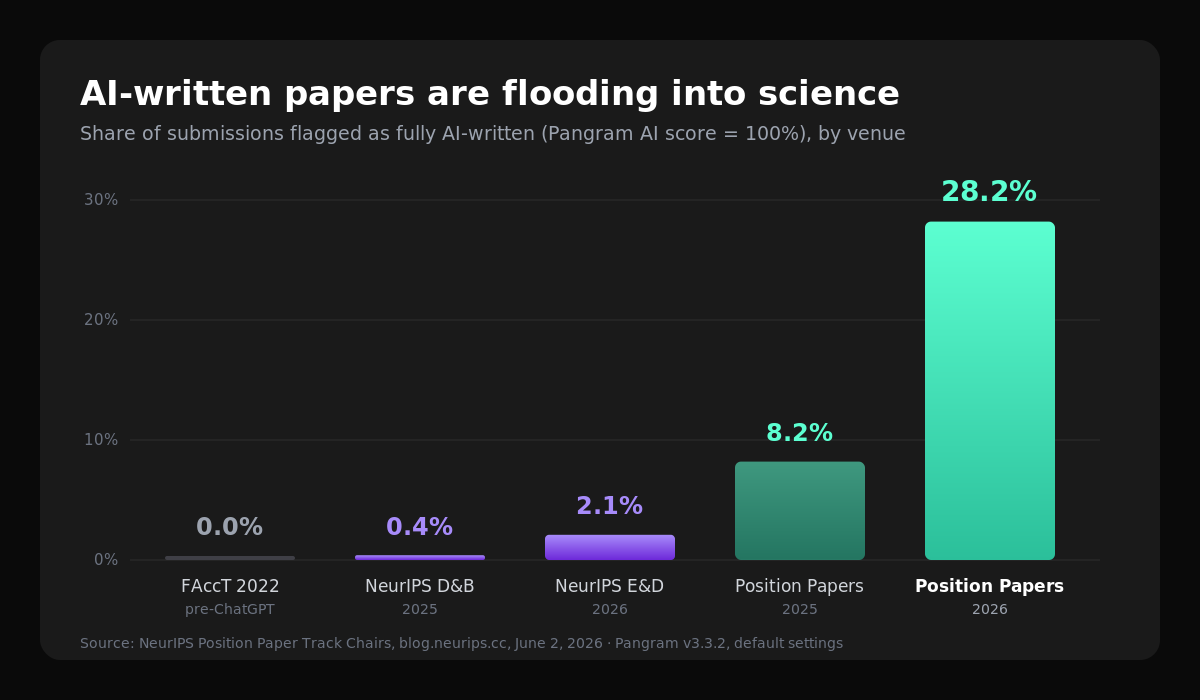
On June 2, the chairs of the NeurIPS 2026 Position Paper Track [announced](https://blog.neurips.cc/2026/06/02/ai-generated-papers-in-the-neurips-2026-position-paper-track/) that 178 submissions (18.4% of the track) will be desk-rejected without review, and another 123 (12.7%) must prove "substantial human engagement" by June 15 or face the same fate. The evidence: a commercial AI-detection model called Pangram, which scored 28.2% of the track's roughly 970 submissions as substantially AI-written.
Read that again. At a conference dedicated to advancing artificial intelligence, nearly a third of authors in one track appear to have let AI write their papers — and the organizers responded by deploying another AI to catch them.
What actually happened
Position papers are argumentative essays about where the field should go — think "AI labs should publish their safety cases" rather than benchmark results. This year, the track introduced a strict rule: papers must be substantially human-written, with AI allowed only for copy-editing and similar peripheral polish.
To check compliance, the chairs ran every submission through Pangram (v3.3.2), which splits a paper into text windows of roughly 250–350 words and estimates the probability that each window contains AI-generated text. The headline result, from the [official NeurIPS analysis](https://blog.neurips.cc/2026/06/02/ai-generated-papers-in-the-neurips-2026-position-paper-track/): 28.2% of submissions received a Pangram AI score of 100% — meaning every part of the paper fell into a window the model believes contains AI-generated text.
The comparison data is striking. Papers from the FAccT conference published in 2022 — before ChatGPT existed — scored 0%. The same position paper track a year earlier: 8.2%. And in NeurIPS's own Evaluations & Datasets track, papers scoring 90% or higher jumped more than tenfold in a single year, from 0.8% to 9.3%. Whatever you think of the policy, the underlying trend is real: AI-written text is flooding into science, fast.
This isn't an isolated skirmish. In March, Nature [reported](https://www.nature.com/articles/d41586-026-00893-2) that a major AI conference rejected 497 papers — about 2% of submissions — because their authors used large language models to write peer reviews, caught via hidden watermarks. Pangram itself [estimated](https://www.pangram.com/blog/pangram-predicts-21-of-iclr-reviews-are-ai-generated) that 21% of reviews at ICLR, another top AI conference, were AI-generated. The reviewers and the reviewed are increasingly the same machines.
The case for the crackdown
The chairs' argument is sharper than a reflexive "AI bad." Their point is about cost-shifting: when an author submits AI-generated text, they externalize the cost of verification onto reviewers, who must now figure out whether slick prose contains actual human ideas the author can stand behind. Peer review runs on volunteer labor and is already [near breaking point](https://www.nature.com/articles/d41586-025-02457-2). An author who delegates writing to a model saves themselves hours while burning the time of three unpaid reviewers.
There's also the accountability question. A position paper is an argument someone is supposed to hold. If a model generated the argument, who exactly is taking the position? The chairs note that AI-generated text "can depart significantly from the authors' original intention" — and to their credit, they ran validation experiments showing Pangram did not flag legitimate uses: proofreading, light copy-editing, even human-AI hybrid revision passed cleanly, and AI completions of 20% or less of a text were never flagged.
The case against
Here's where it gets uncomfortable. Buried in the NeurIPS analysis is a remarkable detail: the result depends heavily on how you configure the detector. With the default 250–350-word windows, 28.2% of papers scored 100%. When the chairs re-ran the analysis with 100-word windows, that number collapsed to 2.16%. Same papers, same detector — a thirteenfold difference based on a settings choice. The chairs argue the smaller windows lose recall, and their thresholds were set conservatively. But careers are being decided by a proprietary black box whose output swings by an order of magnitude depending on configuration.
Then there's the burden of proof. Accused authors must produce a documented version history with "pre-AI" and "post-AI" checkpoints demonstrating their ideas existed before the model touched them. Authors who wrote honestly but drafted in a plain text editor with no version history have, in practice, no defense. The chairs concede the policy's terms are "inherently ambiguous" and that authors who used AI "responsibly" may be indistinguishable from those who didn't. That's an extraordinary admission: the system cannot tell the careful from the careless, so it presumes guilt at a threshold.
And a deeper objection: if AI assistance produces a clearer, better-argued paper, why is that bad? Plenty of researchers — especially those writing in a second language — see AI writing tools as a leveler, not a cheat. Nature reported last year that [more than half of researchers already use AI in peer review](https://www.nature.com/articles/d41586-025-04066-5), often against the rules. When a majority breaks a rule, it's worth asking whether the rule, not the majority, is the problem.
Why this matters beyond academia
The mechanism NeurIPS landed on — prove your work predates the AI, or it doesn't count — is a preview of something much bigger. The chairs say it plainly: "We expect that in future years this kind of audit trail will become a default."
Provenance is about to become infrastructure. The same logic is already creeping into schools, courts, journalism, and hiring. If you write anything professionally — reports, proposals, grant applications, marketing copy — the question "can you prove a human wrote this?" is coming for you too. Version histories, keystroke logs, and signed drafts may become the receipts of knowledge work, the way timestamps and signatures once were.
The irony is thick: the people building the machines that write are now building the machines that catch the machines that write — and both sides will keep improving. Detection and generation are locked in an arms race that detection, most experts suspect, cannot win on pure accuracy. Which is exactly why NeurIPS reached for process evidence instead: don't trust the text, trust the paper trail.
The takeaway
NeurIPS didn't solve the AI-writing problem; it ran the first large-scale experiment in policing it, in public, with its own community as test subjects. Expect appeals, expect lawsuits-adjacent drama, and expect every journal and conference to study this case before writing their own rules. The era when "who wrote this?" had an obvious answer is over. The era of proving it has just begun.
Word count: 1,076 (body text, within the 800–1,200 target)