"Prove a Human Wrote This": The World's Top AI Conference Is Rejecting AI-Written Science
The world's most prestigious AI conference now has an unusual demand for researchers: prove that you, a human being, actually wrote your paper.
On June 2, the organizers of NeurIPS — the Neural Information Processing Systems conference, the closest thing machine learning has to a world championship — [announced](https://blog.neurips.cc/2026/06/02/ai-generated-papers-in-the-neurips-2026-position-paper-track/) that 178 submissions to its 2026 Position Paper Track, 18.4% of everything submitted, will be desk-rejected for being substantially written by AI. Another 123 papers (12.7%) sit in a kind of purgatory: their authors have until June 15 to produce evidence of "substantial human engagement" — version histories, pre-AI drafts, an audit trail of their own thinking — or be rejected too.
Read that again. Nearly a third of the papers submitted to a track at the world's top AI conference were flagged as machine-written. The people building AI are increasingly letting AI do their science for them — and the institution of peer review, already creaking, is being asked to referee a game where it can no longer tell who is playing.
How they caught it
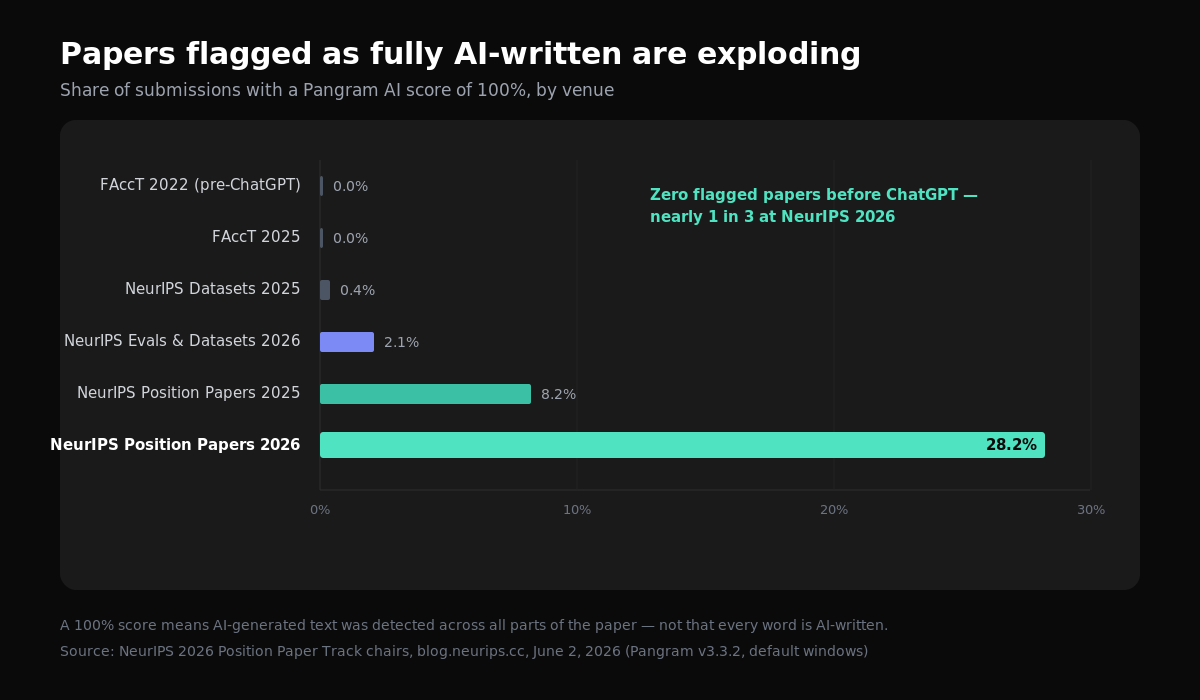
NeurIPS partnered with Pangram, an AI-detection company, to scan all 969 submissions. The headline number: [28.2% of papers received a Pangram AI score of 100%](https://blog.neurips.cc/2026/06/02/ai-generated-papers-in-the-neurips-2026-position-paper-track/), meaning every section of the paper showed signs of AI-generated text. The organizers stress this doesn't mean every word was machine-written — but it does mean AI use far beyond the "copy-editing only" policy authors had agreed to.
The control comparisons are what make the finding hard to dismiss. The same detector run on papers from FAccT 2022 — a similar conference, pre-ChatGPT — flagged exactly zero. NeurIPS's own Datasets track in 2025: 0.4%. The Position Paper Track a year earlier: 8.2%. This year: 28.2%. And in the Evaluations and Datasets track, papers scoring 90% or higher increased more than tenfold in a single year. Whatever your view of AI detectors, the trend line is not subtle.
This isn't an isolated scandal. It's a system eating itself.
Zoom out and the NeurIPS decision is the fourth alarm in six months. In December 2025, a Frontiers survey of roughly 1,600 academics found that [more than half of researchers have used AI for peer review](https://www.nature.com/articles/d41586-025-04066-5) — often against publisher guidance. In January, the detection startup GPTZero reported finding [hundreds of hallucinated, nonexistent citations in at least 53 papers](https://fortune.com/2026/01/21/neurips-ai-conferences-research-papers-hallucinations/) that were accepted and published at NeurIPS 2025 — fabricated references that sailed past three or more human reviewers each. And in March, another major AI conference [rejected 497 papers](https://www.nature.com/articles/d41586-026-00893-2) — about 2% of its submissions — after catching their authors using large language models to write peer reviews, detected through hidden watermarks.
Put the pieces together and you get a grimly funny picture: AI writes the paper, AI reviews the paper, AI invents the citations, and AI fails to notice them. Science as a closed loop, with humans politely holding the door.
The case for the crackdown
The NeurIPS chairs' argument is sharper than "AI bad." Their point is economic: submitting AI-generated text to peer review "externalises the cost of verifying that work, imposing it on reviewers." A human who writes a paper has, at minimum, thought it through. An AI-generated paper might be coherent — or might be confident nonsense — and the only way to know is for an unpaid volunteer reviewer to do the verification the author skipped. At 21,575 submissions to NeurIPS's main track in 2025 (up 75% from 2023), the system has no slack left for that.
The organizers also did their homework on fairness. They tested the detector against twelve realistic writing scenarios and found that permissible uses — proofreading, light copy-editing, even AI-assisted translation — were never flagged. Text needed to be more than 20% AI-completed before the detector reacted at all. Pangram's audited false-positive rate is below 0.1%, and decision thresholds were set conservatively, with desk-rejection reserved for the strongest evidence.
The case against
And yet. The accused are being convicted by a statistical model whose verdict they cannot cross-examine. NeurIPS's own analysis shows how much the methodology matters: with the default text-window size, 42.7% of papers scored 90% or above; shrink the window, and that figure collapses to 12.7%. Same papers, same detector — a threefold difference in apparent guilt, depending on a parameter choice the accused had no say in.
The burden of proof has also quietly flipped. Authors must now maintain version histories proving they thought their own thoughts — innocent until detected. That burden won't fall evenly: researchers writing in a second language, who use AI most legitimately for prose, have the most reason to fear false flags. And there's a deeper inconsistency the policy can't escape: AI is celebrated everywhere else in the research pipeline — generating hypotheses, writing code, analyzing data. Drawing the moral line at prose, critics argue, mistakes the ritual of writing for the substance of science.
Why this lands on your desk, not just theirs
Academia is simply the first industry forced to answer a question that's coming for everyone: when AI can produce competent-looking work instantly, what is your signature actually worth?
The NeurIPS appeals mechanism is the part worth watching. Authors must show a "pre-AI checkpoint" — documented proof that the ideas existed before the machine touched them. Expect that concept to spread. Job applications, consulting reports, legal briefs, school essays: anywhere a document is used to judge a person, "proof of human work" is about to become a deliverable in itself. The organizers say so plainly — they expect this kind of audit trail to "become a default."
That's the real story here, bigger than 178 rejected papers. For four centuries, a signed document implied a human mind behind it. That assumption died sometime in the past two years; institutions are only now writing its obituary. The question NeurIPS just forced into the open — and the one your employer will ask sooner than you think — isn't whether you may use AI. It's whether you can still prove which parts are you.