Prove You're Human: AI's Top Conference Just Rejected Hundreds of Papers Its Own Field Helped Write
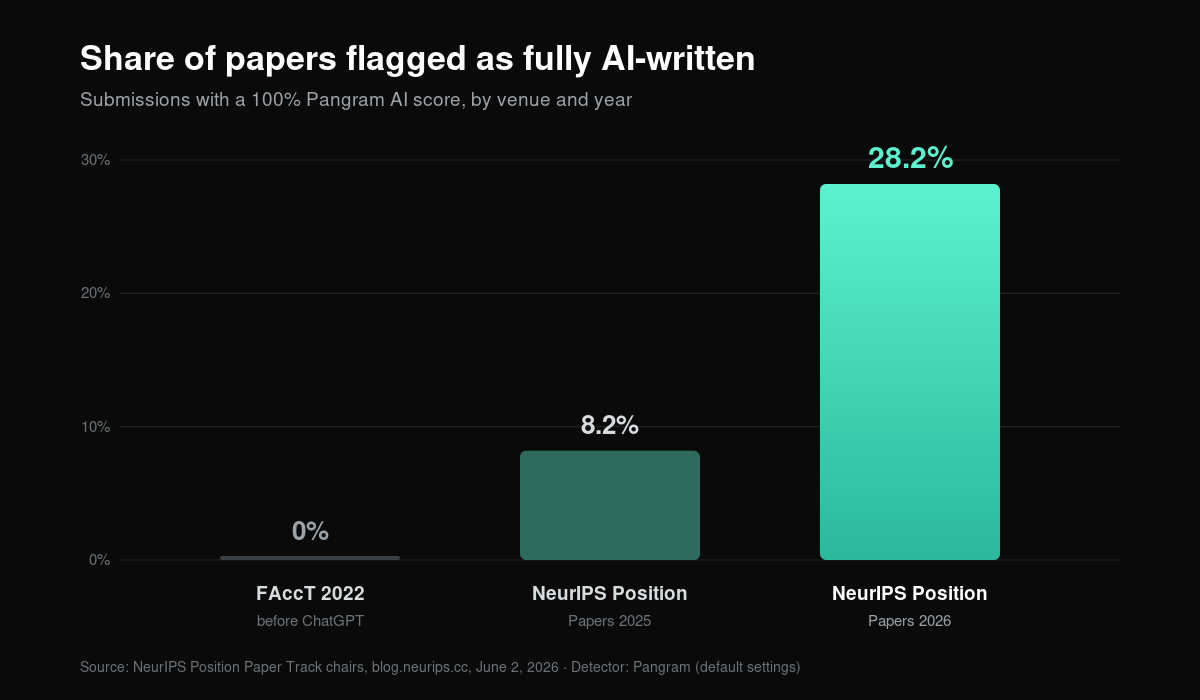
The people who built the machines just caught the machines writing their homework — at industrial scale. On June 2, the organizers of NeurIPS, one of the world's most important AI conferences, reported that 28.2% of the 969 submissions to its 2026 Position Paper Track — 273 papers — were flagged as substantially AI-written. The consequence is unprecedented: 178 papers (18.4%) are desk-rejected outright, no appeal, while 123 (12.7%) have until June 15 to prove a human wrote them. The burden of proof has flipped at the field's flagship venue — and what happens in AI research tends to arrive everywhere else about eighteen months later.
What happened
The Position Paper Track required papers be "substantially human-written," AI allowed only for copy-editing; chairs ran every submission through Pangram, a commercial AI-text detector. The numbers were stark: 70.5% had at least half their text flagged, 28.2% scored a full 100%. By comparison, Pangram flagged 0% of FAccT 2022 papers (before ChatGPT) and 8.2% of the same track a year earlier; in NeurIPS's Evaluations and Datasets track, papers scoring 90%+ rose more than tenfold from 2025 to 2026. Nor is this isolated — in March, Nature reported another conference rejected 497 papers after watermarks revealed LLM-written peer reviews, and a survey found over half of researchers now use AI for review. The machines aren't just writing papers; they're reviewing them too.
The case for the crackdown
The chairs' argument is sharper than the usual hand-wringing about AI slop: it's about cost-shifting. When you submit AI-generated text for review, they write, you "externalise the cost of verifying that work, imposing it on reviewers." A position paper is meant to be a human staking out an argument; if a model generated the prose, reviewers can't know whether any human verified — or even believes — what's on the page.
The case against
The chairs were careful — they stress-tested Pangram, which audits put below 0.1% false positives, and gave borderline cases an appeal. And yet the counterarguments are serious. That sub-0.1% rate still means real authors among 969 submissions may face career consequences from a tool validated, the organizers concede, on only ten samples. The policy line — AI for "copy-editing or similar peripheral changes" — is, in their own words, "inherently ambiguous." There's a fairness problem too: researchers writing in a second language lean on AI to compete with native English speakers, so punishing fluent AI-assisted prose risks punishing the people AI was meant to help. And the hypocrisy charge writes itself — the field selling AI as a productivity revolution, NeurIPS itself promoting a paper-assistant, calls its own writing too important to automate. The chairs object only to AI writing the final text — but the line between "AI helped me think" and "AI wrote it" is one nobody can reliably draw.
Why this lands on your desk
Here's the part that matters beyond academia. The appeals process requires a version history — a "pre-AI" checkpoint proving the ideas were yours, a "post-AI" checkpoint, and an analysis showing the AI added no substance — an audit trail the chairs predict "will become a default." Extend that to job applications, university essays, legal filings, journalism: as AI writing becomes indistinguishable from human writing, value shifts from the text to its provenance — the trail showing a human did the thinking. "Show your work" is coming back, this time for adults. The everyday skill won't be writing prose, which models do, but directing, verifying, and taking responsibility for it. The chairs ruled responsibility cannot be delegated even when the typing is; whether that survives a world where every email and memo flows through a model is the open question ahead.
The takeaway
NeurIPS didn't just reject some papers. It ran the first large-scale experiment in policing the boundary between human and machine authorship — detector, thresholds, appeals, audit trails and all. The result: even among the world's leading AI experts, reputations on the line, roughly a quarter couldn't resist letting the machine write. Expect every institution you deal with to face the same question soon, and expect many to copy this playbook. The era of proving you wrote it has begun.