AI Is Quietly Eating Its Own Output. One Real Fact Might Stop It.
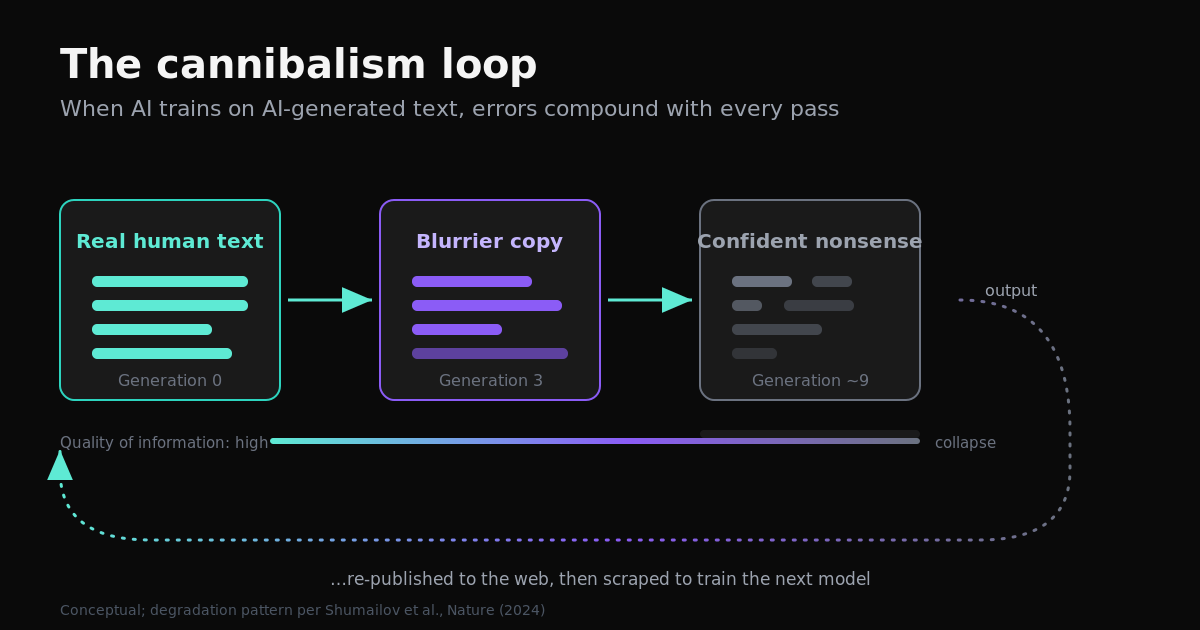
The web is filling up with AI-written text, and the next generation of AI will be trained partly on it. So what happens when a machine learns mostly from the output of other machines — a photocopy of a photocopy? In 2024, Oxford and Cambridge researchers named the answer: model collapse. Train a model on its own output, repeat the loop, and it doesn't just stagnate — it curdles. Published in Nature, their experiments showed output degrading until, after roughly nine rounds, the model produced confident nonsense, detached from the real world it was meant to describe ([Shumailov et al., Nature, 2024](https://www.nature.com/articles/s41586-024-07566-y)). Two years on, that warning has collided with a hopeful new finding — and a backlash from researchers who call the panic overblown.
Why this isn't a niche worry
Model collapse landed hard because of timing: leading labs are running low on high-quality human text. Epoch AI estimates the usable stock of public human-generated text at roughly 300 trillion tokens and projects models will exhaust it between 2026 and 2032 ([Villalobos et al., Epoch AI, 2024](https://epoch.ai/publications/will-we-run-out-of-data-limits-of-llm-scaling-based-on-human-generated-data)). The tempting substitute is synthetic data — cheap, abundant, and exactly the diet the Nature study says causes collapse. Critics call it "data cannibalism": each generation trained on the last one's exhaust gets blurrier and more averaged-out, losing the rare, weird, true details at the edges of human knowledge first.
The hopeful twist: one data point
A 2026 study complicates the doom narrative — in a good way. Researchers from King's College London, the Norwegian University of Science and Technology, and the Abdus Salam International Centre for Theoretical Physics took a mathematically clean class of models (Exponential Families) and proved that in a fully closed loop, collapse is guaranteed — but introduce a single real data point from the outside world, or even a "prior belief" from earlier knowledge, and collapse is averted ([Physical Review Letters, 2026](https://journals.aps.org/prl/accepted/10.1103/156q-3ngc); [King's College London](https://www.kcl.ac.uk/news/scientists-come-up-with-way-to-overcome-ai-data-cannibalism)). That anchor keeps working "even when the amount of machine-generated datapoints is infinitely larger" — a drop of real water purifies an ocean of recycled stuff. The authors are careful: they studied simple statistical models, not ChatGPT. But collapse may be less a cliff than a failure mode a thin tether to reality can prevent.
Both sides, fairly
So is model collapse an existential threat to AI, or a lab curiosity?
The case that it's serious: The internet is a shared training ground nobody controls. As AI-generated content becomes a larger share of what's online, future models will inhale it whether their makers want to or not. The Nature results show the failure isn't gentle — the informative tails of the distribution vanish, and rare knowledge is lost first. Train AI on a polluted commons and quality could erode in ways that are hard to detect until they're baked in.
The case that it's overstated: Real labs don't train in a blind closed loop. They accumulate data as new human content keeps arriving, and they curate, filter, and mix synthetic with real. A pointed 2025 paper argues the scary scenarios rely on unrealistic assumptions, like fully replacing real data with synthetic and ignoring that humans keep writing ([Position: Model Collapse Does Not Mean What You Think, arXiv, 2025](https://arxiv.org/abs/2503.03150)). Used carefully, synthetic data powers many of today's best models, and the King's result reinforces the point: it takes shockingly little grounding to stay safe. Both camps are partly right — pure recursive training is poison, but the apocalyptic version assumes labs are careless in a way they mostly aren't. The real risk lives in the murky middle: a web where provenance is unknown and "human" data is increasingly AI-written without a label.
So what — for you
This debate quietly raises the value of something you produce every day: original, human, real-world information. If a single authentic data point can anchor a model, then verified human content — your reviews, photos, writing, corrections — grows more valuable, not less, as synthetic content multiplies. Expect fights over data provenance, content licensing, and "is this even real" labeling to intensify. The tools you rely on aren't doomed to get dumber, but they're only as grounded as the real data their makers keep feeding them — and an open web flooded with unlabeled AI text quietly degrades the training ground everyone draws from.
Takeaway
The cannibalism scare and the one-data-point cure are two halves of the same lesson: AI can't bootstrap itself out of reality. It needs a steady tether to the genuine, human, messy world — and the good news from 2026 is that the tether can be thin. The catch is that someone has to keep holding the other end. As synthetic content becomes the ocean, the real question isn't whether AI collapses — it's who makes sure a drop of truth keeps getting in.
Note on sourcing: the "nine generations" degradation comes from the Nature 2024 study's experiments. The 2026 King's College London result is a proof on simplified statistical models (Exponential Families and Restricted Boltzmann Machines), not yet validated on large neural networks like ChatGPT — the authors flag this themselves.