The AI Jobs Apocalypse Was Canceled. So Why Can't Graduates Find Work?
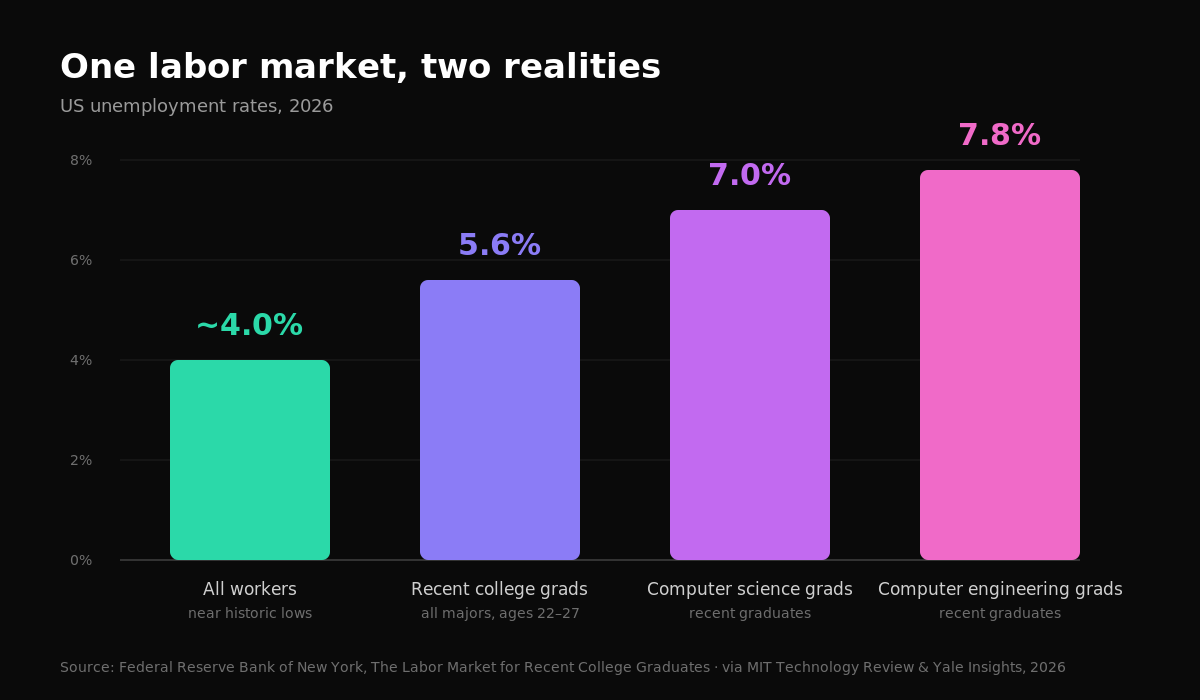
Here is a puzzle. The AI jobs apocalypse — the one where half of white-collar work evaporates — has not arrived. US unemployment sits near historic lows at around 4%, and [MIT Technology Review's reality check published in late May](https://www.technologyreview.com/2026/05/26/1137855/a-reality-check-on-the-ai-jobs-hysteria/) found "scant evidence that AI has yet had any large-scale impact on the US labor market." And yet: if you're 23 and looking for your first proper job, the market is the worst it has been since the pandemic. Both statements are backed by hard data. The question is which one tells you the truth about the future.
The apocalypse that didn't show up
The doomsday predictions were loud. Anthropic CEO Dario Amodei [warned in 2025](https://www.axios.com/2025/05/28/ai-jobs-white-collar-unemployment-anthropic) that AI could wipe out half of all entry-level white-collar jobs within five years. Verizon's CEO [predicted](https://www.wsj.com/tech/ai/the-ceo-preaching-straight-talk-about-ai-and-job-losses-a3aaaaf1) unemployment could rise by up to 30%.
The data refuses to cooperate. Erika McEntarfer, the labor economist who headed the US Bureau of Labor Statistics until late 2025, puts it plainly in MIT Technology Review: "All of the available evidence to date suggests that AI's impact on current labor market conditions is likely small right now." [US Census data](https://www.census.gov/hfp/btos/data) shows only one in five companies uses AI in any business function at all. A [National Bureau of Economic Research study](https://www.nber.org/papers/w34836) surveying nearly 6,000 C-suite executives found AI has had little to no impact on employment or productivity in almost 90% of firms over the past three years. Even coding — supposedly the first profession on the chopping block — is still growing: a [Federal Reserve Board paper](https://www.federalreserve.gov/econres/feds/files/2026018pap.pdf) found employment for coders continues to rise, just about three percentage points slower per year than before ChatGPT.
Case closed? Not quite.
The canaries
In November 2025, Erik Brynjolfsson and colleagues at Stanford's Digital Economy Lab published a working paper with an ominous title: ["Canaries in the Coal Mine?"](https://digitaleconomy.stanford.edu/app/uploads/2025/11/CanariesintheCoalMineNov25.pdf) Using payroll data from ADP — a far larger dataset than government surveys — they sorted 950 occupations by AI exposure and tracked who was actually getting hired.
The headline finding: a 16% relative decline in employment for workers aged 22 to 25 in the most AI-exposed occupations, such as software development and customer service. Meanwhile, head count for older workers in the very same occupations grew. So did jobs in less-exposed fields. The damage is real, but it is surgically concentrated on people trying to take their first step.
The supporting evidence stacks up. [New York Fed data](https://www.newyorkfed.org/research/college-labor-market) puts unemployment for recent college graduates at roughly 5.6% — well above the rate for all workers — with computer science and computer engineering graduates at 7.0% and 7.8%, comparable to fine arts majors. [Yale's Chief Executive Leadership Institute](https://insights.som.yale.edu/insights/the-real-job-destruction-from-ai-is-hitting-before-careers-can-start) notes that software development postings on Indeed have fallen 53% from their late-2022 peak, and a Goldman Sachs analysis estimates AI is already reducing US employment by roughly 16,000 jobs per month.
Why both sides are right
The Stanford team found a detail that explains the whole puzzle. Job losses were concentrated where AI is used to automate — to do tasks "with minimal human involvement." But in jobs where AI augments human work, entry-level head count actually grew faster than average.
Entry-level work is disproportionately built from what the researchers call codified knowledge — the stuff you learn from books and courses, which is exactly what large language models absorbed from their training data. Senior work runs on tacit knowledge: judgment, context, experience. AI can mimic the first kind cheaply. It cannot yet replicate the second.
That produces a disruption that is nearly invisible in headline statistics. As the Yale authors put it, companies are not firing — they are quietly not hiring. Layoffs make headlines; unfilled graduate schemes don't. When Salesforce [cut roughly 4,000 customer-service roles](https://insights.som.yale.edu/insights/the-real-job-destruction-from-ai-is-hitting-before-careers-can-start) after AI agents took over about half of customer interactions, it made the news. The thousands of junior positions that were simply never advertised did not. Economists have started calling it the "big freeze": hiring rates at levels last seen in 2010, when unemployment was nearly 10%.
The skeptics still have a serious counterargument. The decline in young tech hiring [may have begun before ChatGPT existed](https://arxiv.org/pdf/2601.02554), suggesting interest rates and post-pandemic correction did much of the damage. Even the Stanford authors concede other factors contributed, and stress the effects could level off as firms and workers adapt. History is on the skeptics' side, too: Geoffrey Hinton said in 2016 that we should "stop training radiologists" — and there are more radiologists than ever.
What this means for you
If the canary thesis is right, the threat isn't that AI takes your job. It's that AI takes the job you would have learned yours in. The "earn while you learn" model — hire juniors for routine work, let experience accumulate — breaks if the routine work goes to a model that costs cents per task. A generation could be locked out not by layoffs, but by doors that never open. And the ladder problem compounds: companies that automate away their junior ranks today have no one to promote in ten years.
There's a practical signal in the data, though. The augmentation finding cuts both ways: people who use AI to multiply their output are being hired more, not less. The dividing line running through the labor market isn't junior versus senior so much as replaceable-by-AI versus amplified-by-AI — and which side you land on is partly a choice. Fluency with these tools is becoming what spreadsheet literacy was in the 1990s, except the transition is happening in years, not decades.
The takeaway
Watch the entry level, not the unemployment rate. The headline numbers say nothing is happening; the bottom rung of the career ladder says something already is. Whether it stays contained to a sliver of occupations or spreads upward as AI agents grow more capable is, as McEntarfer says, "the most important question facing us right now." The canaries are singing more quietly than they used to. It's worth listening.