The People Building AI Just Got Caught Letting AI Do Their Writing
There's a special kind of irony in this one: the world's most prestigious AI conference just rejected hundreds of papers written by AI researchers — because they let AI write the papers.
On June 2, the chairs of the NeurIPS 2026 Position Paper Track [announced](https://blog.neurips.cc/2026/06/02/ai-generated-papers-in-the-neurips-2026-position-paper-track/) that 178 submissions — 18.4% of the entire track — will be desk-rejected for violating the conference's AI-writing policy. Another 123 submissions (12.7%) have until June 15 to prove a human substantially wrote them, or they're out too. Add it up and nearly a third of all papers in the track are in trouble.
These are not lazy students padding an essay. These are professional AI researchers, submitting to NeurIPS — the field's flagship venue — in a track explicitly dedicated to arguments and opinions about where AI should go. The one place where the entire point is what humans think, and a detector says many of them outsourced the thinking-on-paper to a model.
What actually happened
NeurIPS introduced a strict rule for its Position Paper Track this year: papers must be substantially human-written, with AI allowed only for copy-editing and similar surface-level polish. Authors had to declare their AI use at submission.
To check compliance, the chairs partnered with Pangram, a commercial AI-detection company. The headline number from their analysis: [28.2% of the 969 submissions](https://blog.neurips.cc/2026/06/02/ai-generated-papers-in-the-neurips-2026-position-paper-track/) received a Pangram AI score of 100% — meaning every section of the paper landed in a text window the detector flagged as containing AI-generated writing.
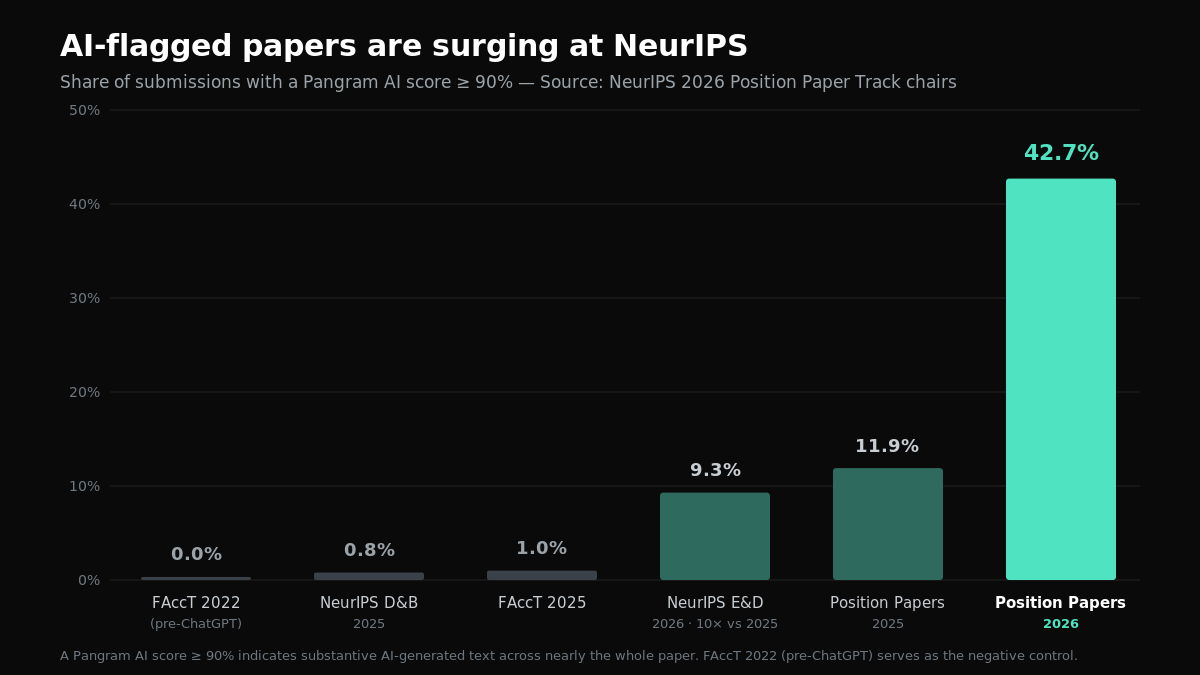
The trend line is steeper than the snapshot. In the same track last year, 11.9% of papers scored 90% or above. This year: 42.7%. In the conference's Evaluations and Datasets track, papers scoring 90%+ jumped more than tenfold year over year. For comparison, papers from the FAccT conference in 2022 — before ChatGPT existed — scored 0.0%.
And this isn't an isolated incident. In March, Nature [reported](https://www.nature.com/articles/d41586-026-00893-2) that another major AI conference rejected 497 papers — about 2% of submissions — after watermarks revealed authors had used large language models to write their peer reviews of other people's work. Nature has also reported that [more than half of researchers now use AI for peer review, often against guidance](https://www.nature.com/articles/d41586-025-04066-5). The machinery of science is quietly filling up with machine-written text, at the input and the output.
The case for the crackdown
The NeurIPS chairs' argument is sharper than "AI bad." Their point is about cost-shifting: when you submit AI-generated text to peer review, you export the work of verifying it onto unpaid reviewers. AI prose is slick, but it can drift from what the authors actually meant — and a reviewer can't tell whether a human checked every claim or whether nobody did. As the chairs put it, AI-generated text "is often slick, but can depart significantly from the authors' original intention."
They also did unusually careful homework. Worried about false accusations, they re-ran the detector with smaller text windows (dropping the 90%+ flag rate from 42.7% to 12.7%), tested it against twelve simulated AI-use scenarios, and confirmed that permissible uses — proofreading, light copy-editing — were never flagged, while fully AI-authored passages reliably were. Pangram's audited false-positive rate is reported below 0.1%. The desk-rejection thresholds were deliberately conservative, combining detector scores with author declarations and submission patterns.
The case against
Critics — and [reaction has been split](https://digg.com/ai/2949nh0c) — make three points worth taking seriously.
First, the hypocrisy problem: this is a community that celebrates AI writing code, proving theorems, and drafting legal briefs. Drawing the line at its own papers looks self-serving. If AI assistance is the future of knowledge work everywhere else, why is the AI research paper sacred?
Second, no detector is infallible, and the consequences here are career-relevant. A false positive doesn't cost a student a grade; it costs a researcher a publication and a reputation. Even a 0.1% false-positive rate, applied across thousands of papers and many venues, means real innocent people get burned. Authors who write in English as a second language have long worried that polished-but-formulaic prose triggers detectors disproportionately.
Third, the line itself is blurry. The policy permits "copy-editing" but bans "substantive AI rewriting." Somewhere between fixing a comma and generating a paragraph lies a vast gray zone — heavy line-editing, restructuring, translation — that the chairs themselves label "borderline." Punishing people for crossing a line nobody can precisely draw is an uncomfortable precedent.
Why this reaches far beyond academia
Here's the part that matters even if you'll never read a NeurIPS paper: the appeals process is a preview of how all knowledge work may soon be policed.
Authors who want to contest their rejection must hand over a version history of their document — a "pre-AI" checkpoint proving they developed the ideas themselves, a "post-AI" checkpoint showing what the model touched, and evidence that humans verified the result. The chairs state plainly that they expect this kind of audit trail "will become a default" in future years.
Think about what that means. The burden of proof is flipping. Until now, your work was presumed yours unless someone proved otherwise. In a world saturated with AI text, the presumption inverts: you may need receipts showing you did the thinking. Lawyers, journalists, consultants, students, marketers — anyone whose output is words — could face the same demand: not just deliver the work, but document the process that proves a human was driving.
That's a profound shift in how we define authorship, and it's arriving not through legislation but through institutions quietly changing their defaults, one conference at a time.
The takeaway
The real story isn't that AI researchers got caught being lazy. It's that even the community building these tools hasn't figured out where assistance ends and authorship dies — and they're now improvising the rules under pressure, with detectors as judges and version histories as alibis. The rest of us should watch closely, because whatever norms survive this experiment will eventually govern how your work gets judged too. The age of "prove a human wrote this" has officially begun.