Are We Borrowing Brainpower We'll Have to Pay Back? The Case for "Cognitive Debt"
Here's an uncomfortable idea: the more you let AI think for you, the less able you may become to think for yourself — measurably, after weeks rather than decades. That's the claim behind cognitive debt: like financial debt, the deal is tempting up front and the bill arrives later as weaker memory, thinner critical thinking, and skills that quietly atrophy. For anyone writing, drafting, or summarizing with AI, the question is whether that debt is real, how big, and whether it's worth paying.
What the research actually found
The phrase comes from a 2025 MIT Media Lab study bluntly titled Your Brain on ChatGPT. Researchers wired 54 students with EEG headsets to write essays using ChatGPT, a search engine, or nothing. The brain-only group showed the strongest, most distributed neural connectivity; ChatGPT users the weakest. Most strikingly, asked to quote a sentence from an essay they'd written minutes earlier, 83% of the AI group couldn't — the work had barely passed through their memory ([MIT Media Lab](https://www.media.mit.edu/publications/your-brain-on-chatgpt/), [arXiv](https://arxiv.org/abs/2506.08872)).
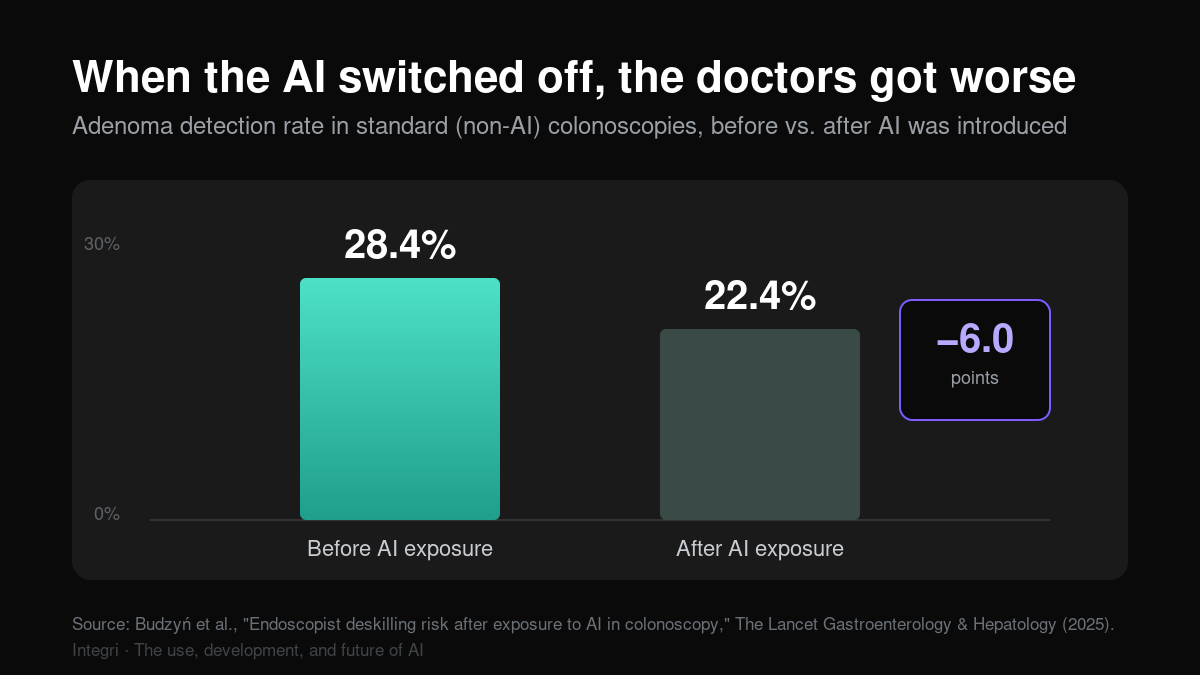
A brain-scan study of students is easy to wave away; a Polish hospital system is harder. In The Lancet Gastroenterology & Hepatology (August 2025), researchers tracked colonoscopies at four centres before and after they adopted AI polyp-detection. When doctors later worked without the AI, their adenoma detection rate — tied to whether cancers get caught — fell about six points below the pre-AI baseline, the first real-world evidence of "automation-induced deskilling" in medicine ([The Lancet Gastroenterology & Hepatology](https://www.thelancet.com/journals/langas/article/PIIS2468-1253(25)00133-5/abstract), [American College of Gastroenterology](https://gi.org/journals-publications/ebgi/zhousep2025/)). A 2025 survey of 666 people points the same way: heavier AI users scored lower on critical thinking, with "cognitive offloading" the mechanism ([Societies / MDPI](https://www.mdpi.com/2075-4698/15/1/6)).
The strongest case for worrying
The deskilling argument is compelling because it doesn't require AI to be bad at its job. The colonoscopy AI worked; the harm came from the humans around it. When a tool reliably does the looking and the remembering, the brain sensibly stops bothering. Skill is kept by effort — remove the effort and it drifts away.
Scale that up. If AI hollows out the judgment of radiologists, pilots, junior lawyers, and writers, we get a workforce that looks productive while the AI is on and is dangerously diminished the moment it fails, hallucinates, or isn't there. The debt is paid not just by individuals but by every system that assumed its experts were still experts.
The strongest case for calm
Now the other side, at its best. The science is shaky: Your Brain on ChatGPT is a non-peer-reviewed preprint of 54 students, only 18 of whom finished; critics flag the small sample and the leap from "different brain activity" to "decline" — different isn't worse ([Transparency Coalition](https://www.transparencycoalition.ai/news/learn-about-the-this-is-your-brain-on-chatgpt-study-results-limitations-risks-and-more), [Science/AAAS](https://www.science.org/content/article/scienceadviser-your-brain-chatgpt)). Much of the broader literature is correlational — heavy AI users may simply be different people, not people made worse.
There's also history. Around 370 BC, Socrates warned writing would destroy memory; he was wrong that it made us stupid. Calculators, GPS, and search triggered identical panics — all offloading we were glad to do, how each generation reallocates its mental budget. Crucially, the same research warning about unguided AI finds that guided, reflective use — having AI challenge your draft or generate counterarguments — can strengthen thinking. The variable isn't whether you use AI, but whether you stay in the loop or hand over the wheel.
So what — for your work and your week
The honest read isn't "AI makes you dumber" but narrower: offloading a skill you've stopped practising is how you lose it, and AI makes offloading effortless — pointing to habits, not abstinence. Use AI to pressure-test your thinking: draft first, then ask it to poke holes. Keep occasionally doing what you've delegated — write the summary, do the math, read the source — and treat high-stakes work (medical, legal, financial) as something to verify, not trust. Heed the MIT memory test: if you can't say what's in the document you just "wrote," you didn't really write it.
Takeaway
Cognitive debt is real enough to take seriously and too new to panic over. The future it points to isn't AI quietly making humanity dumber — it's a widening gap between people who use AI to think harder and those who use it to stop thinking. The technology won't decide which group you're in; your habits will. Borrow the brainpower when it helps — just don't forget how to earn it back.