The World's Top AI Conference Just Rejected 178 Papers — for Being Written by AI
There is something almost theatrical about it: the world's most prestigious AI conference deployed an AI to catch researchers who used AI to write papers about AI. And it found a lot.
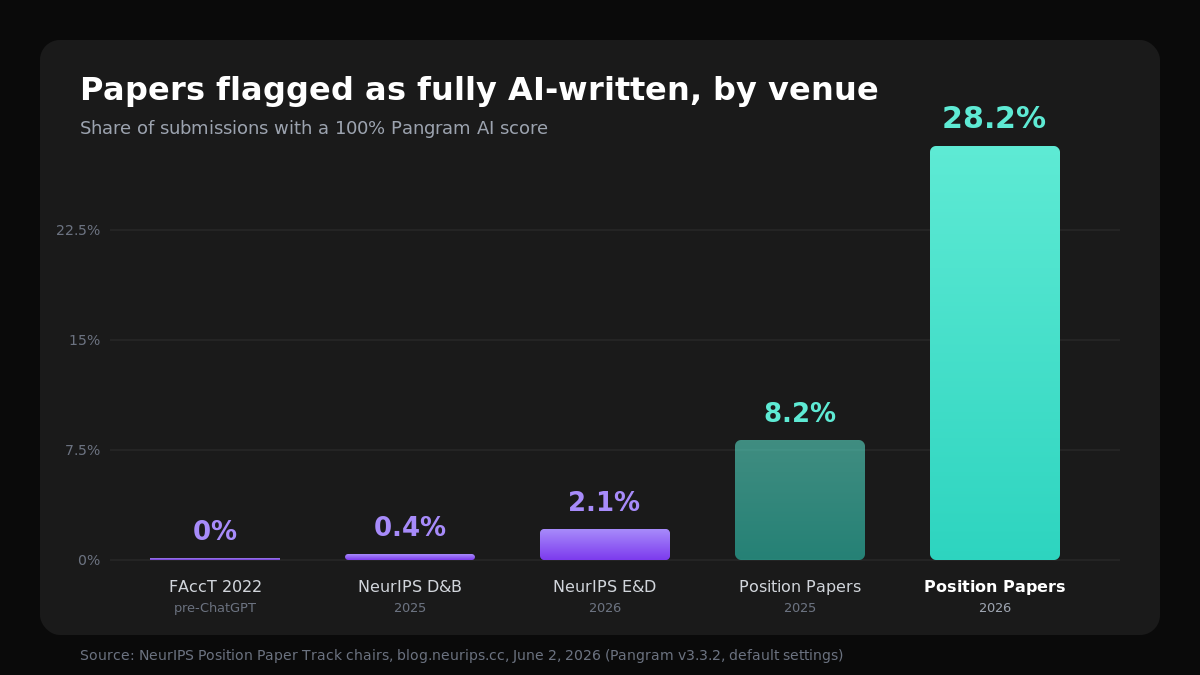
Last week, the chairs of the NeurIPS 2026 Position Paper Track [announced](https://blog.neurips.cc/2026/06/02/ai-generated-papers-in-the-neurips-2026-position-paper-track/) that 28.2% of submissions — 273 of 969 papers — got a perfect 100% score from Pangram, a commercial AI-text detector. The track required papers be "substantially human-written," with AI allowed only for copy-editing; nearly a third didn't comply. The consequences aren't symbolic: 178 submissions (18.4%) are being desk-rejected with no standard appeal, and another 123 (12.7%) had until June 15 to prove a human wrote them. The fight is now bigger than one track: when an AI accuses you of using AI, who carries the burden of proof?
What NeurIPS found
The organizers didn't take Pangram's word blindly, and their analysis is worth taking seriously. Control sets held up: FAccT 2022 papers, written before ChatGPT existed, scored 0%, and accepted ICLR 2026 papers flagged only 1% of the time, against an audited false-positive rate reported under 0.1%. Legitimate AI use passed too — proofreading or light copy-editing flagged nothing, and AI completions of 20% or less were never caught; only from-scratch or substantive rewrites tripped it. The trend is also unmistakable: perfect 100% scores in the track jumped from 8.2% to 28.2% in a year. Their core argument is economic, not about purity: "submitting AI-generated text for peer review externalises the cost of verifying that work, imposing it on reviewers." An author can generate a plausible paper in an afternoon; a reviewer still needs hours. Multiply by hundreds and the system collapses.
The case against the verdict
The backlash was immediate, and not only from the accused. The most uncomfortable number is buried in NeurIPS's own post: the verdict swings with how you slice the text. At default settings (250–350-word windows), 42.7% of submissions scored 90%+; with 100-word windows, that fell to 12.7% — a 30-point swing from a configuration authors never saw and couldn't contest. There's history, too: a 2023 Stanford study in Patterns found GPT detectors [misclassified more than half of essays written by non-native English speakers](https://arxiv.org/abs/2304.02819) as AI, while scoring native speakers nearly perfectly — and machine learning is a heavily non-native-English field. Then the burden of proof: authors who used AI must now produce version histories with "pre-AI" and "post-AI" checkpoints proving their ideas came first. Fair cost-bearing, or a presumption of guilt enforced by a proprietary black box? Both are accurate — which is what makes it hard. The organizers concede there will "inevitably be borderline cases" and that the policy "will not be the last word."
This is not just an academia story
Don't file this under inside-baseball. The same collision is coming to every domain where writing is evidence of thinking. Science is just first because the volume is unmanageable: Nature [reported](https://www.nature.com/articles/d41586-025-04066-5) that more than half of researchers already use AI in peer review, often against guidelines, and in March [another major AI conference rejected 497 papers](https://www.nature.com/articles/d41586-026-00893-2) after watermarks revealed reviewers had used LLMs to write the reviews — AI-written papers, judged by AI-written reviews. Your workplace runs on the same assumption academia just lost: that a document proves someone thought. The cover letter, the proposal, the performance review all face the NeurIPS question, and the likely answer is the one it prototyped — provenance. Expect version histories and "pre-AI checkpoints" to become the receipts you keep, not because anyone trusts detectors but because nobody fully does. It cuts both ways: proofreading and translating your own ideas sailed through. AI on your sentences is a tool; AI replacing your thinking is a substitution.
The takeaway
NeurIPS didn't solve the problem; it ran the first large-scale experiment on it, in public, with real casualties. The detector will be challenged, some appeals will succeed, and next year's authors will adapt — some by writing honestly, some by prompting better. But the deeper shift is already locked in: human authorship is no longer the default assumption. It's becoming a claim you have to be able to back up.
— Word count: 670 (condensed from 1,050).