Bolivia experiences a day of political tension, road blockades, and new commercial advances
Today, Bolivia's Chamber of Deputies has on its agenda the treatment of a bill regarding states of exception. This proposal arises at a time of great social pressure, where various sectors are calling for order to be restored in the country. However, President Rodrigo Paz's government has stated that a state of exception is the last resort and prefers to seek other solutions. For her part, Deputy Lissa Claros denounced that groups following Evo Morales have threatened to attack the homes of legislators who approve this law.
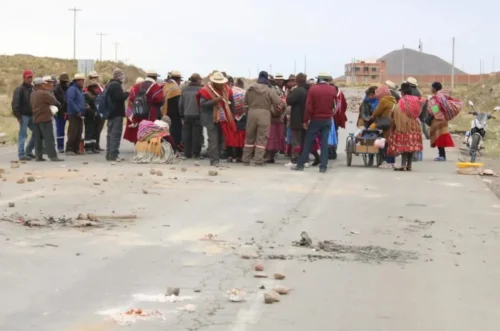
The situation on Bolivian highways is complicated due to the protests. The Bolivian Highway Administration (ABC) reported more than 70 active blockade points this Thursday, with the departments of Cochabamba and La Paz being the most affected. Violence was also present on the Oruro–La Paz route, where a group of protesters attacked a truck carrying a family with stones. The attack destroyed the vehicle's windshield and endangered the driver, his wife, and his daughter.
In response to these blockades, citizens have begun to mobilize. In the mining district of Llallagua, in Potosí, residents marched through the streets to demand that the pressure measures affecting the supply of products be lifted. At the same time, the sectors known as "evistas" have called for a cabildo or mass assembly in Caracollo for this Friday, coinciding with the legislative debates in the capital.
In the economic aspect, the exchange market recorded significant movements during the Corpus Christi holiday. The dollar in the parallel market started the day surpassing the barrier of 10 bolivianos, although it finally closed the day at 9.95 bolivianos for purchase. These changes reflect the economic uncertainty accompanying the current political conflict.
To mitigate the impact of the blockades on citizens' pockets, the La Paz Mayor's Office announced that it will continue with the direct sale of chicken meat. According to official Dockweiler, the goal is to avoid intermediaries and offer a kilogram of chicken at 28 bolivianos. This measure seeks to ensure that families in La Paz have access to basic foods despite transport difficulties.
Finally, in the midst of the crisis, positive news for foreign trade was announced. Thanks to the activation of new air freedom agreements, the first Tampa Cargo plane arrived in Bolivia. This new international route will connect the city of Santa Cruz with important logistics centers around the world, facilitating cargo transport and opening new opportunities for the Bolivian economy.