AfD takes narrow lead in Mecklenburg as Berlin swings left
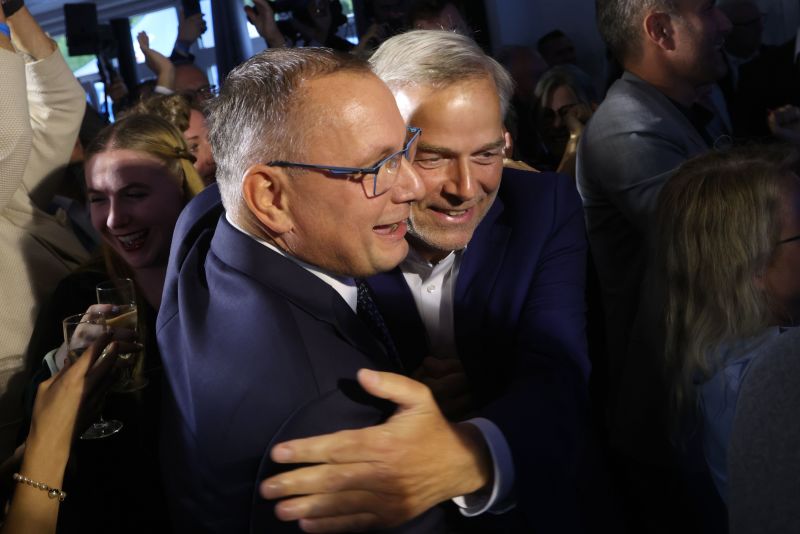
The Social Democrats and the far-right Alternative for Germany (AfD) are neck and neck in Mecklenburg, according to exit polls, with the AfD holding a narrow lead.
SPD’s Manuela Schwesig and AfD challenger Leif-Erik Holm are projected at around 36.5% and 38%, respectively, in the sparsely populated northern, coastal state bordering Poland.
The AfD has roughly doubled its 2021 result in the state, building on its near-majority in neighbouring Saxony-Anhalt and putting another eastern German state within reach.
The result still caps a momentous comeback for Schwesig and the Social Democrats, who surged in the final weeks of the campaign.
“This will be a long night,” Schwesig told her supporters in the picturesque orangerie of Schwerin castle. Further vote counts could yet see her close the gap to her far-right rival.
However, “it hurts to see that massive blue bar,” the SPD politician said, referring to the AfD’s colour.
Meanwhile, AfD co-leader Tino Chrupalla hailed the result as “exceptional”, telling supporters at the party’s election-night celebration that the AfD would now seek to govern the state.
The Greens and Die Linke also cleared the 5% threshold to enter the state parliament, according to the projection.
For Chancellor Friedrich Merz’s Christian Democrats, the result is another severe blow. The CDU is projected at just 5% – by far its worst-ever result in any election since the Second World War.
Berlin
In the capital, meanwhile, the far left is set to command 26%, according to exit polls, with Die Linke doubling their 2023 result of 12.2%.
A triumphant Elif Eralp, the party’s lead candidate, called the result a message of “love and justice” to the world.
The Social Democrats and Greens sit at 12% and 15.5%, respectively, while the AfD earned 13.5% of the vote.
Together, the three left-wing parties are on course for a majority, opening the door to a return of left-wing government in the capital – this time under Die Linke leadership.
The SPD lead candidate, Steffen Krach, who slipped to fifth place, called the result “catastrophic”. His party had dominated Germany’s capital city for decades.
Merz’s Christian Democrats came in at just 20%. The CDU has governed Berlin for the past three years after a surprise election victory fuelled by frustration with Green policies and wider anger over the state of the city.
So far, 72% of Berliners voted, nine percentage points higher than in 2023. In Mecklenburg-Western Pomerania, turnout reached 75.5%, up from 70.8% in 2021.