KAIST Develops AI Technology to Restore Satellite Imagery Through Clouds and Darkness
Published
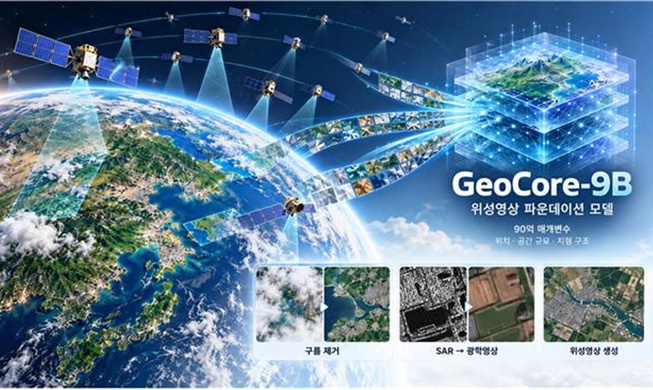
A research team at the Korea Advanced Institute of Science and Technology (KAIST) has developed an artificial intelligence (AI) technology that can obtain clear satellite imagery even in cloudy conditions or during the dark of night. Existing satellite imagery has been limited by its heavy dependence on weather conditions, making it difficult to acquire information, but this new technology provides a solution to these problems.
The newly developed AI technology works by removing clouds from blurred images captured by satellites and enhancing the quality of nighttime images that lack sufficient light. The research team designed the AI to restore images on its own by training it on vast amounts of satellite data. This is expected to allow for more accurate utilization of satellite information in various fields, such as disaster response and military purposes.
Recently, South Korea has solidified its position as a technological powerhouse, ranking first in Asia in the Global Innovation Index. This satellite image restoration technology is also being evaluated as a significant achievement that elevates South Korea's competitiveness in the space industry to the next level.
Once this technology is applied to actual satellites in the future, the quality of public services such as weather observation and national land management is expected to improve significantly. As South Korea's space technology continues to advance day by day, it is expected that more innovative technologies will make our lives more convenient.
Sources: Korea.net
More South Korea news
- Digital TVET master's program launches in South Korea
- Gyeongbuk health group donates 100 boxes of grapes to children
- US Big Tech Pursues Multi-Trillion Won Investments in South Korean Data Centers Amid Uncertainty
- KB Insurance to Hold Open Recruitment for New Employees in Second Half of 2026
- Kolmar Korea Wins CES Beauty Tech Best Innovation Award for Second Straight Year, Setting World First
- China Closes In on Korea's Core LNG Carrier Market, Expanding from Mega-Vessels to Equipment
- China's Rapid Technological Development: South Korea Must Change Its Regulations and Labor System
- Ambassador Michelle Steel: American Companies Operating in Korea Should Compete in a Fair Environment